Ch. 16 - Reactions of Aldehydes and Ketones • More Reactions of Carboxylic Acid Derivatives
Bruice - Organic Chemistry 8th Edition
Bruice8th EditionOrganic ChemistryISBN: 9780135213711Not the one you use?Change textbook
Chapter 17, Problem 65b

Identify A through O:
Diagram illustrating a series of radical reactions with labeled steps A through O, showing chemical transformations and reagents.

Verified step by step guidance
1
Step 1: Analyze the starting material. The given compound is a cyclohexene ring with a methyl group attached to one of the carbons in the ring. The double bond is located between two carbons in the ring.
Step 2: Identify the reagent and reaction type. Bromine (Br₂) is used, which typically reacts with alkenes via an electrophilic addition mechanism. This reaction involves the addition of bromine across the double bond.
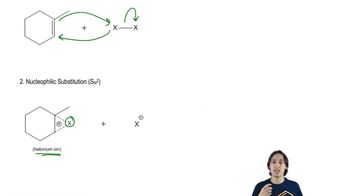
Step 3: Predict the intermediate. The double bond in the cyclohexene ring will react with Br₂, forming a bromonium ion intermediate. This intermediate is a three-membered ring structure where bromine is bonded to both carbons of the former double bond.
Step 4: Determine the final products. The bromonium ion is attacked by a bromide ion (Br⁻), leading to the formation of a dibromo product. The bromine atoms will add anti to each other (on opposite sides of the ring) due to the stereochemistry of the reaction.
Step 5: Assign labels A and B. A represents the major product, which is the dibromo compound formed from the addition of bromine across the double bond. B represents the bromide ion (Br⁻) that is released during the reaction.

Verified video answer for a similar problem:

This video solution was recommended by our tutors as helpful for the problem above.
Video duration:
6m
Was this helpful?

Key Concepts

Here are the essential concepts you must grasp in order to answer the question correctly.

Halogenation

Halogenation is a chemical reaction that involves the addition of halogens, such as bromine (Br2), to an organic compound. In this process, the halogen atoms replace hydrogen atoms in alkenes or react with other functional groups, leading to the formation of haloalkanes or other halogenated compounds. Understanding this reaction is crucial for predicting the products formed in the given reaction.
Recommended video:
Guided course
03:45
Halogenation Mechanism

Mechanism of Electrophilic Addition

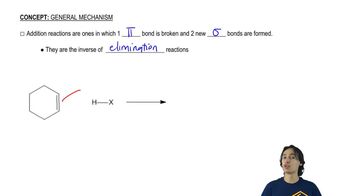
The mechanism of electrophilic addition describes how electrophiles, like Br2, react with nucleophilic sites in alkenes or cycloalkenes. The reaction typically proceeds through the formation of a cyclic bromonium ion intermediate, which is then attacked by a nucleophile, leading to the formation of the final products. This concept is essential for understanding how compounds A and B are generated from the starting material.
Recommended video:
Guided course
05:39
Features of Addition Mechanisms.

Stereochemistry of Products

Stereochemistry refers to the spatial arrangement of atoms in molecules and how this affects their chemical behavior. In halogenation reactions, the formation of products can lead to stereoisomers, such as enantiomers or diastereomers, depending on the configuration of the reactants and the reaction conditions. Recognizing the stereochemical implications is important for identifying the specific structures of compounds A and B.
Recommended video:
1:38
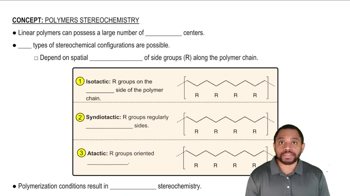
Polymer Stereochemistry Concept 1