Draw the structures of four six-carbon alkenes that form the same product, whether they react with HBr in the presence of a peroxide or with HBr in the absence of a peroxide.
Ch. 12 - Radicals
Chapter 13, Problem 37b
Which product would be obtained in greatest yield? Explain.
Verified step by step guidance1
Identify the type of reaction taking place (e.g., substitution, elimination, addition, etc.) and the reactants involved. This will help determine the possible products.
Analyze the reaction conditions (e.g., solvent, temperature, catalyst, etc.) to understand how they influence the reaction mechanism and the stability of the products.
Determine the stability of the possible products by considering factors such as resonance, hyperconjugation, steric hindrance, and electronic effects. The most stable product is typically formed in the greatest yield.
Apply the concept of regioselectivity or stereoselectivity, if relevant, to predict which product is favored. For example, in electrophilic addition reactions, Markovnikov's rule or anti-Markovnikov's rule may apply.
Conclude which product is obtained in the greatest yield based on the analysis of stability, reaction mechanism, and selectivity, and provide a clear explanation for your reasoning.

Verified video answer for a similar problem:
This video solution was recommended by our tutors as helpful for the problem above.
Was this helpful?
Key Concepts
Here are the essential concepts you must grasp in order to answer the question correctly.
Reaction Mechanism
Understanding the reaction mechanism is crucial for predicting the products of a chemical reaction. It involves the step-by-step process by which reactants are converted into products, including the formation and breaking of bonds. Knowledge of intermediates and transition states can help determine which product is favored under specific conditions.
Recommended video:
Guided course
Heck Reaction Mechanism
Thermodynamics
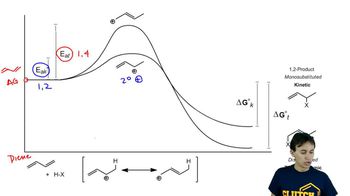
Thermodynamics plays a key role in determining the stability of products formed in a reaction. The Gibbs free energy change (ΔG) indicates whether a reaction is spontaneous and can help predict which product will be obtained in greater yield. A lower energy product is generally more stable and thus more likely to be formed in higher amounts.
Recommended video:
Guided course
Kinetic vs. Thermodynamic Control
Kinetics
Kinetics refers to the rate of a chemical reaction and how it influences product formation. Factors such as temperature, concentration, and the presence of catalysts can affect the speed at which products are formed. Understanding the kinetics can help identify which product will be produced more quickly and in greater yield, especially in competitive reactions.
Recommended video:
Guided course
Kinetic vs. Thermodynamic Control
Related Practice
Textbook Question
956
views
Textbook Question
Propose a mechanism to account for the products formed in the following reaction:
958
views
Textbook Question
The deuterium kinetic isotope effect for the halogenation of an alkane is defined in the following equation, where X・ = Cl・ or Br・
Predict whether chlorination or bromination would have a greater deuterium kinetic isotope effect.
1215
views
Textbook Question
How many monochlorination products would be obtained if all stereoisomers are included?
1144
views
Textbook Question
What five-carbon alkene forms the same product whether it reacts with HBr in the presence of a peroxide or with HBr in the absence of a peroxide?
1324
views
Textbook Question
How many monochlorination products can be obtained from the radical chlorination of methylcyclohexane? Disregard stereoisomers.
1116
views