Ch. 10 - Reactions of Alcohols, Ethers, Epoxides, Amines, and Sulfur-Containing Compounds
Bruice - Organic Chemistry 8th Edition
Bruice8th EditionOrganic ChemistryISBN: 9780135213711Not the one you use?Change textbook
Chapter 11, Problem 57

Identify A–E.

Verified step by step guidance
1
Step 1: Analyze the first reaction. The starting compound is cyclohexene, which reacts with bromine (Br₂) in water (H₂O). This is a halohydrin formation reaction. Bromine adds across the double bond, and water provides the hydroxyl group (-OH). The product A is a bromohydrin, where one carbon of the double bond gets a bromine atom and the other gets a hydroxyl group.
Step 2: Identify B. In the halohydrin formation reaction, bromine reacts with water, and one of the byproducts is hydrobromic acid (HBr). Thus, B is HBr.
Step 3: Examine the second reaction. Compound A reacts with hydroxide ion (HO⁻). This is an elimination reaction where the hydroxide ion removes a proton, leading to the formation of an epoxide (C). The bromine atom is eliminated, and the oxygen from the hydroxyl group forms a three-membered ring with the two carbons.
Step 4: Analyze the third reaction. Compound C (the epoxide) reacts with hydroxide ion (HO⁻) in water (H₂O). This is a ring-opening reaction. The hydroxide ion attacks one of the carbons in the epoxide, breaking the ring and forming a diol (D). The two hydroxyl groups (-OH) are added to the carbons that were part of the epoxide ring.
Step 5: Identify E. In the ring-opening reaction, water is used as a solvent, but no additional byproducts are formed. Therefore, E is simply water (H₂O), which remains in the reaction mixture.

Verified video answer for a similar problem:

This video solution was recommended by our tutors as helpful for the problem above.
Video duration:
6m
Was this helpful?

Key Concepts

Here are the essential concepts you must grasp in order to answer the question correctly.

Functional Groups

Functional groups are specific groups of atoms within molecules that are responsible for the characteristic chemical reactions of those molecules. Understanding functional groups is essential in organic chemistry as they dictate the behavior and properties of organic compounds. Common examples include hydroxyl (-OH), carboxyl (-COOH), and amino (-NH2) groups.
Recommended video:
Guided course
02:36
Identifying Functional Groups

Nomenclature

Nomenclature in organic chemistry refers to the systematic naming of organic compounds based on their structure and functional groups. The International Union of Pure and Applied Chemistry (IUPAC) provides rules for naming compounds, which helps in identifying the structure and properties of the molecules. Mastery of nomenclature is crucial for effective communication and understanding in the field.
Recommended video:
4:02
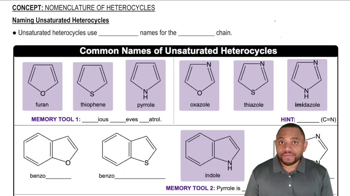
Nomenclature of Heterocycles Concept 2

Structural Isomerism

Structural isomerism occurs when compounds have the same molecular formula but different structural arrangements of atoms. This concept is vital in organic chemistry as isomers can exhibit vastly different physical and chemical properties. Understanding structural isomerism helps in predicting reactivity and interactions of organic compounds.
Recommended video:
Guided course
06:47
Monosaccharides - D and L Isomerism