Skip to main content
Organic Chemistry
My Course
Learn
Exam Prep
AI Tutor
Study Guides
Textbook Solutions
Flashcards
Explore
Try the app
My Course
Learn
Exam Prep
AI Tutor
Study Guides
Textbook Solutions
Flashcards
Explore
Try the app
Back
Acids and Bases definitions
You can tap to flip the card.
Lewis Acid
You can tap to flip the card.
👆
Lewis Acid
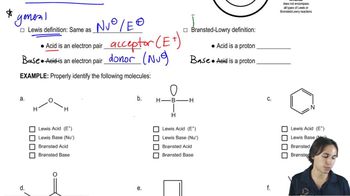
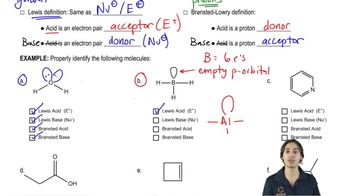
An electron pair acceptor, often overlapping with electrophiles, but not always a proton donor.
Track progress
Control buttons has been changed to "navigation" mode.
1/15
Related flashcards
Related practice
Recommended videos
Acids and Bases quiz #1
Acid and Base Definitions
36 Terms
Acids and Bases quiz #2
Acid and Base Definitions
40 Terms
Acids and Bases quiz #3
Acid and Base Definitions
38 Terms
Acids and Bases
3. Acids and Bases
7 problems
Topic
Johnny
Equilibrium Constant
3. Acids and Bases
7 problems
Topic
Johnny
3. Acids and Bases - Part 1 of 2
4 topics
10 problems
Chapter
Laura
3. Acids and Bases - Part 2 of 2
3 topics
9 problems
Chapter
Johnny
07:46
Lewis vs. Bronsted-Lowry Definition
5404
views
39
rank
72
comments
00:54
The Bronsted-Lowry definition of acids and bases.
5342
views
40
rank
1
comments
02:11
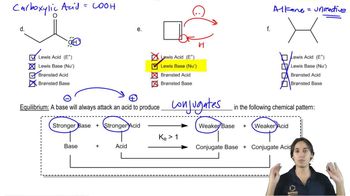
Equilibrium constant and conjugates.
4199
views
35
rank
4
comments
Terms in this set (15)
Hide definitions
Lewis Acid
An electron pair acceptor, often overlapping with electrophiles, but not always a proton donor.
Lewis Base
An electron pair donor, typically a nucleophile, capable of sharing lone pairs in reactions.
Bronsted-Lowry Acid
A proton donor, usually also a Lewis acid, but defined specifically by its ability to give protons.
Bronsted-Lowry Base
A proton acceptor, often also a Lewis base, defined by its ability to accept protons.
Electrophile
A species with an affinity for electrons, often acting as an electron pair acceptor in reactions.
Nucleophile
A species rich in electrons, seeking positive centers and acting as an electron pair donor.
Conjugate Acid
The product formed when a base gains a proton during an acid-base reaction.
Conjugate Base
The product formed when an acid loses a proton during an acid-base reaction.
Chemical Equilibrium
A state in which forward and reverse reactions occur at equal rates, determining reaction direction.
Equilibrium Constant
A value (Ke) indicating the extent to which a reaction favors products or reactants at equilibrium.
Octet Rule
A principle stating that atoms tend to have eight electrons in their valence shell for stability.
Carboxylic Acid
A functional group (COOH) known for its acidic hydrogen, easily donating protons in reactions.
Pyridine
A nitrogen-containing aromatic ring with a lone pair, acting as both a Lewis and Bronsted base.
Strong Acid
A substance that completely dissociates in solution, such as HCl, and is essential to recognize in reactions.
Lone Pair
A pair of valence electrons not involved in bonding, often responsible for base or nucleophile behavior.
 BackBack

 07:46
07:46