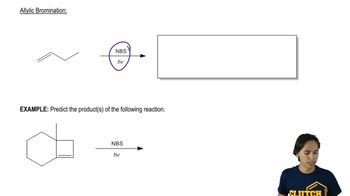
An allylic position is the carbon atom adjacent to a double bond.
Why are allylic radicals more stable than tertiary, secondary, or primary radicals?
Allylic radicals are more stable because they can be stabilized by resonance with the adjacent double bond.
What is the initiation step in allylic bromination?
The initiation step involves the homolytic cleavage of Br2 to form two bromine radicals.
During the propagation step, what does the bromine radical do?
The bromine radical abstracts a hydrogen atom from the allylic position, forming HBr and an allylic radical.
How does resonance affect the allylic radical formed during halogenation?
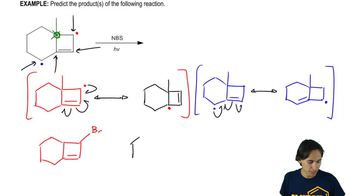
Resonance allows the allylic radical to be delocalized over multiple positions, leading to the possibility of multiple products.
Why can allylic halogenation produce a mixture of products?
Because the allylic radical can resonate to different positions, halogenation can occur at more than one carbon, resulting in a mixture of products.
What reagent and conditions are commonly used for allylic chlorination?
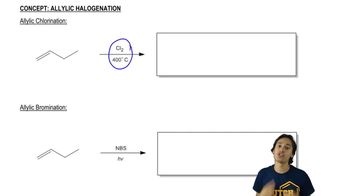
Allylic chlorination typically uses Cl2 at 400 degrees Celsius.
What reagent is commonly used for allylic bromination and why?
NBS (N-bromosuccinimide) is commonly used with light or heat to provide a low, steady concentration of bromine radicals and avoid addition to the double bond.
What is the main difference between halogenation at a tertiary carbon and at an allylic position?
Halogenation at a tertiary carbon usually gives a single product, while allylic halogenation can give multiple products due to resonance.
What happens in the termination step of allylic halogenation?
In the termination step, two radicals combine to form a stable, non-radical product, which can include various structures due to resonance.
How can you predict the number of products formed in allylic halogenation?
Draw all possible resonance structures of the allylic radical to determine the number of different products.
Why is it important to use only trace amounts of bromine in allylic bromination?
Using only trace amounts prevents bromine from adding directly to the double bond, ensuring selective allylic bromination.
What is the role of light or heat in allylic bromination with NBS?
Light or heat initiates the formation of bromine radicals from NBS, starting the radical chain reaction.
What is the product of the propagation step when a bromine radical reacts with an allylic radical?
The product is an allylic bromide and a new bromine radical, which continues the chain reaction.
How do you determine if a reaction will give one product or a mixture in allylic halogenation?
If the double bond is not symmetrical, resonance leads to a mixture of products; otherwise, only one product is formed.
 Back
Back
 04:28
04:28