Back

Calculating Radical Yields definitions

Control buttons has been changed to "navigation" mode.
1/15
  • Radical Halogenation

    A reaction where a halogen atom replaces a hydrogen atom in an alkane via a radical mechanism, producing various isomeric products.
  • Tertiary Radical

    A carbon-centered species with three alkyl groups attached, exhibiting the highest stability among alkyl radicals.
  • Secondary Radical

    A carbon-centered species with two alkyl groups attached, more stable than primary but less than tertiary radicals.
  • Primary Radical

    A carbon-centered species with one alkyl group attached, showing the lowest stability among alkyl radicals.
  • Relative Rate

    A numerical value expressing how quickly a specific type of hydrogen is replaced during halogenation compared to others.
  • Chlorination

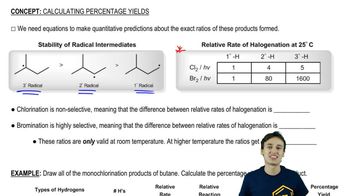
    A halogenation process using chlorine, characterized by low selectivity and the formation of multiple products.
  • Bromination

    A halogenation process using bromine, noted for its high selectivity and strong preference for tertiary carbons.
  • Selectivity

    A measure of how much a reaction favors one type of hydrogen or carbon over others during product formation.
  • Major Product

    The compound formed in the greatest amount during a reaction, determined by both stability and reaction rates.
  • Minor Product

    A compound formed in smaller quantities during a reaction, often due to less favorable stability or slower rates.
  • Room Temperature

    A standard condition, typically 25°C, under which selectivity ratios for halogenation are experimentally determined.
  • Quantitative Method

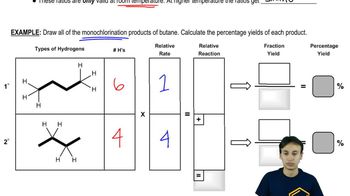
    A systematic approach using equations and numerical data to calculate exact product distributions in reactions.
  • Stability Trend

    The order of radical stability: tertiary > secondary > primary, influencing product distribution in halogenation.
  • Product Distribution

    The relative amounts of different compounds formed in a reaction, influenced by selectivity and radical stability.
  • Isomeric Product

    A compound with the same molecular formula as others formed in the reaction but differing in the arrangement of atoms.