What is the general trend of radical stability in halogenation reactions?
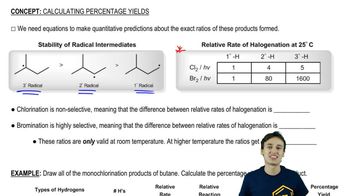
Tertiary radicals are more stable than secondary radicals, which are more stable than primary radicals.
Why is chlorination considered non-selective in radical halogenation?
Chlorination is non-selective because it only slightly prefers tertiary carbons over primary and secondary carbons, resulting in many different products.
How much more does chlorination prefer tertiary carbons compared to primary carbons?
Chlorination prefers tertiary carbons about 5 times more than primary carbons.
What is the selectivity ratio for bromination between tertiary and primary carbons?
Bromination favors tertiary carbons 1600 times more than primary carbons, making it highly selective.
How does increasing the temperature affect selectivity in radical halogenation reactions?
Increasing the temperature reduces selectivity, making the difference between primary, secondary, and tertiary carbons smaller.
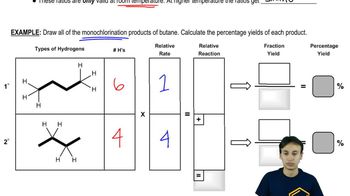
What quantitative method is used to calculate exact percentages of products in radical halogenation?
Equations based on relative rates of halogenation at a specific temperature are used to calculate product percentages.
At what temperature are the selectivity ratios for halogenation typically measured?
The selectivity ratios are typically measured at room temperature, which is 25 degrees Celsius.
Why is bromination described as highly selective compared to chlorination?
Bromination is highly selective because the difference in relative rates between tertiary and primary carbons is very large.
What happens to bromination selectivity at higher temperatures?
At higher temperatures, bromination becomes less selective and may produce more varied products.
Why are rounded values used for teaching radical halogenation selectivity ratios?
Rounded values are used for simplicity and consistency, even though actual values may vary slightly between sources.
What should you do if your professor uses different selectivity values than those taught in the video?
You should use the values your professor provides, as the concepts remain the same regardless of the exact numbers.
What is the main reason for the variety of products in chlorination reactions?
The main reason is chlorination's low selectivity, which leads to halogenation at multiple types of carbons.
How can the exact ratio of major and minor products be determined in radical halogenation?
The exact ratio can be determined using the relative rates of halogenation for each type of carbon.
What is the effect of ambient energy on selectivity in radical halogenation?
More ambient energy (higher temperature) decreases selectivity, making the reaction less discriminating between carbon types.
What is the safest approach when encountering different selectivity values in textbooks?
Use the rounded values provided for teaching, but follow your professor's instructions if different values are required.
 Back
Back
 04:32
04:32