Skip to main content
Organic Chemistry
My Course
Learn
Exam Prep
AI Tutor
Study Guides
Textbook Solutions
Flashcards
Explore
Try the app
My Course
Learn
Exam Prep
AI Tutor
Study Guides
Textbook Solutions
Flashcards
Explore
Try the app
Back
Functional Groups definitions
You can tap to flip the card.
Functional Group
You can tap to flip the card.
👆
Functional Group
A set of atoms within a molecule that imparts characteristic chemical reactivity and properties, simplifying classification of organic compounds.
Track progress
Control buttons has been changed to "navigation" mode.
1/24
Related flashcards
Related practice
Recommended videos
Functional Groups quiz #1
Functional Groups
38 Terms
Functional Groups quiz #2
Functional Groups
40 Terms
Functional Groups quiz #3
Functional Groups
39 Terms
Functional Groups
2. Molecular Representations
6 problems
Topic
Johnny
How To Determine Solubility
2. Molecular Representations
7 problems
Topic
Johnny
2. Molecular Representations
3 topics
10 problems
Chapter
Ernest
01:30
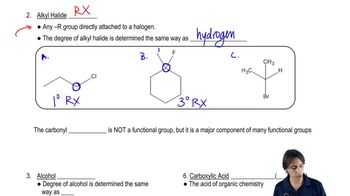
Assigning Degrees to Alkyl Halides
4818
views
50
rank
6
comments
01:49
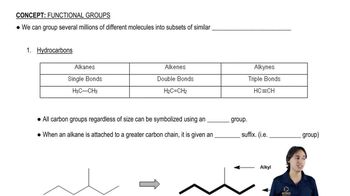
Why we need functional groups.
6665
views
93
rank
3
comments
03:08
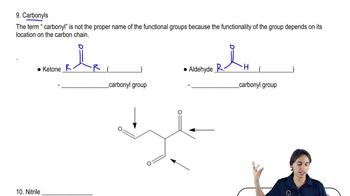
The difference between aldehydes and ketones.
4740
views
43
rank
9
comments
Terms in this set (24)
Hide definitions
Functional Group
A set of atoms within a molecule that imparts characteristic chemical reactivity and properties, simplifying classification of organic compounds.
Hydrocarbon
A molecule composed solely of carbon and hydrogen atoms, forming the backbone for many organic compounds.
Alkane
A saturated hydrocarbon containing only single bonds between carbon atoms, often forming the simplest organic structures.
Alkene
An unsaturated hydrocarbon featuring at least one carbon-carbon double bond, increasing reactivity compared to single bonds.
Alkyne
A hydrocarbon with at least one carbon-carbon triple bond, resulting in linear geometry and high reactivity.
R Group
A generic symbol representing any carbon-containing group in a molecule, used to simplify complex structures.
Alkyl Halide
A compound where a halogen atom is directly bonded to a carbon group, often denoted as RX in condensed formulas.
Alcohol
A functional group where a hydroxyl group (OH) is attached to a carbon atom, commonly written as ROH.
Amine
A nitrogen-containing group bonded to one or more carbon groups, with classification based on the number of attached carbons.
Ether
A functional group with an oxygen atom connected to two carbon groups, typically represented as ROR.
Carbonyl
A structural feature consisting of a carbon atom double-bonded to an oxygen atom, present in many reactive groups.
Carboxylic Acid
A group containing a carbonyl and hydroxyl on the same carbon, often written as COOH, known for acidic properties.
Amide
A functional group with a carbonyl bonded to a nitrogen atom, formed by combining an amine and a carbonyl.
Ester
A group with a carbonyl adjacent to an oxygen bonded to another carbon, commonly written as COOR, often with pleasant odors.
Ketone
A carbonyl group bonded to two carbon atoms, always internal within a carbon chain, never at the end.
Aldehyde
A carbonyl group at the end of a carbon chain, bonded to at least one hydrogen, often abbreviated as CHO.
Nitrile
A functional group featuring a carbon triple-bonded to a nitrogen atom, denoted as CN in condensed formulas.
Benzene
A six-carbon aromatic ring with alternating double bonds, serving as a core structure in many organic molecules.
Phenyl
A benzene ring directly attached to a larger molecule, often abbreviated as Ph or C6H5.
Benzyl
A benzene ring attached to a molecule via a CH2 group, distinguished from phenyl by this extra carbon.
Acyl Chloride
A group with a carbonyl bonded to a chlorine atom, highly reactive, often written as COCl.
Anhydride
A functional group with two carbonyls linked by an oxygen atom, often formed from two carboxylic acids.
Thiol
A sulfur analog of alcohol, with an SH group attached to a carbon, known for strong odors.
Sulfide
A sulfur analog of ether, with a sulfur atom bonded to two carbon groups, similar in structure to ethers.
 BackBack

 01:30
01:30