Back

Hybridization definitions

Control buttons has been changed to "navigation" mode.
1/15
  • Aufbau Principle

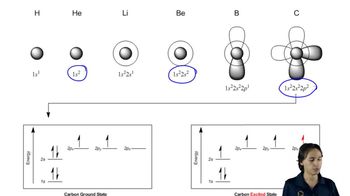
    Describes the order in which electrons fill atomic orbitals, starting from the lowest energy to higher energy levels.
  • Electron Configuration

    Represents the arrangement of electrons in atomic orbitals, crucial for predicting bonding and reactivity.
  • Hybridization

    Process where atomic orbitals blend to form new, equivalent orbitals optimized for bonding.
  • sp3 Hybridization

    Involves mixing one s and three p orbitals, resulting in four identical orbitals with 109.5° bond angles.
  • sp2 Hybridization

    Involves mixing one s and two p orbitals, resulting in three identical orbitals with 120° bond angles.
  • sp Hybridization

    Involves mixing one s and one p orbital, resulting in two identical orbitals with 180° bond angles.
  • Bond Site

    Any location on an atom where a bond or lone pair exists, used to determine hybridization.
  • Degenerate Orbitals

    Orbitals that possess the same energy, often formed after hybridization.
  • s Character

    Percentage of s orbital contribution in a hybrid orbital, influencing properties like acidity.
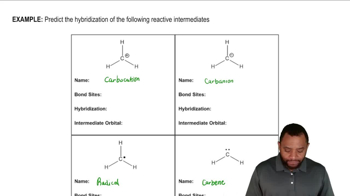
  • Carbocation

    A reactive intermediate with a positively charged carbon, lacking a complete octet.
  • Carbanion

    A reactive intermediate with a negatively charged carbon, often highly reactive.
  • Radical

    A reactive intermediate with an unpaired electron, making it highly unstable.
  • Carbene

    A neutral reactive intermediate with two nonbonded electrons and only six valence electrons.
  • Bond Angle

    The geometric angle between adjacent bonds, determined by the type of hybridization.
  • Unhybridized Orbital

    An atomic orbital that does not participate in hybridization, often involved in pi bonding.