Which base is found only in RNA? Ribose, Thymine, Uracil, Deoxyribose
Uracil is the base found only in RNA.
What is the job of mRNA?
mRNA transfers genetic information from DNA to the ribosome for protein synthesis.
Which molecule is not a type of RNA?
DNA is not a type of RNA.
Which of these is responsible for catalyzing the formation of an RNA primer?
Primase is responsible for catalyzing the formation of an RNA primer.
What is not a difference between DNA and RNA?
Phosphate group is not a difference between DNA and RNA; both have phosphate groups.
What are the components of a nucleotide?
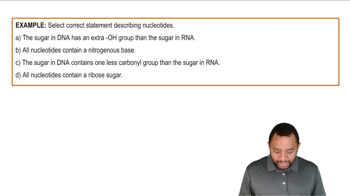
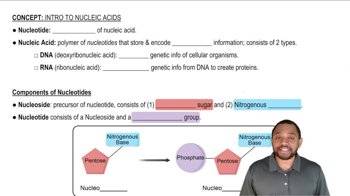
A nucleotide consists of a phosphate group, a pentose sugar, and a nitrogenous base.
What are the three components of a nucleotide?
The three components of a nucleotide are a phosphate group, a pentose sugar, and a nitrogenous base.
What is the monomer of DNA?
The monomer of DNA is a nucleotide.
Which is a disadvantage of using DNA technology?
A disadvantage of using DNA technology is the potential for ethical concerns and privacy issues.
Rosalind Franklin used what technique in her study of DNA molecules?
Rosalind Franklin used X-ray diffraction in her study of DNA molecules.
Which types of light are absorbed by genetic material?
Ultraviolet light is absorbed by genetic material.
Which part of a deoxynucleoside triphosphate (dNTP) molecule provides the energy for DNA synthesis?
The phosphate groups of a dNTP provide the energy for DNA synthesis.
What are the components of a nucleotide?
A nucleotide consists of a phosphate group, a pentose sugar, and a nitrogenous base.
What are the 3 types of RNA?
The three types of RNA are mRNA, tRNA, and rRNA.
Which molecule has codons and is used to tell tRNA which amino acid is needed?
mRNA has codons and is used to tell tRNA which amino acid is needed.
Which is an advantage of using DNA technology?
An advantage of using DNA technology is the ability to diagnose genetic disorders and develop targeted therapies.
What are the three parts of a nucleotide?
The three parts of a nucleotide are a phosphate group, a pentose sugar, and a nitrogenous base.
Who conducted the X-ray diffraction studies that were key to the discovery of the structure of DNA?
Rosalind Franklin conducted the X-ray diffraction studies that were key to the discovery of the structure of DNA.
Which types of light are not absorbed by genetic material?
Visible light is not absorbed by genetic material.
How many types of RNA are there?
There are three types of RNA: mRNA, tRNA, and rRNA.
What is the role of mRNA?
mRNA carries genetic information from DNA to the ribosome for protein synthesis.
What does the mRNA codon AUG code for?
The mRNA codon AUG codes for the amino acid methionine and serves as the start codon for translation.
What are the chemical components of a DNA nucleotide?
A DNA nucleotide consists of a phosphate group, deoxyribose sugar, and a nitrogenous base.
Why is PCR used in the process of DNA sequencing?
PCR is used to amplify specific DNA sequences, making them easier to study and sequence.
Which enzyme covalently links nucleotides together?
DNA ligase covalently links nucleotides together.
What technique used by Wilkins and Franklin helped reveal the structure of DNA?
X-ray diffraction was the technique used by Wilkins and Franklin to help reveal the structure of DNA.
What is the monomer of nucleic acid?
The monomer of nucleic acid is a nucleotide.
How many nucleotides are in 12 mRNA codons?
There are 36 nucleotides in 12 mRNA codons (3 nucleotides per codon).
What is a codon?
A codon is a sequence of three nucleotides that codes for a specific amino acid.
What is one way that RNA differs from DNA?
RNA contains the sugar ribose, while DNA contains the sugar deoxyribose.
What are the three differences between RNA and DNA?
RNA contains ribose sugar, uracil instead of thymine, and is typically single-stranded, while DNA contains deoxyribose sugar, thymine, and is double-stranded.
What is the monomer (building block) for nucleic acids?
The monomer for nucleic acids is a nucleotide.
What is the monomer (building block) for DNA?
The monomer for DNA is a nucleotide.
Which molecule is not found in RNA: Ribose, Uracil, Thymine, or Phosphate group?
Thymine is not found in RNA.
Which scientist made X-ray diffraction photos of DNA?
Rosalind Franklin made X-ray diffraction photos of DNA.
Rosalind Franklin used what technique in her study of DNA molecules?
Rosalind Franklin used X-ray diffraction in her study of DNA molecules.
The “backbone” of the DNA molecule is made up of two alternating components. What are they?
The backbone of the DNA molecule is made up of alternating sugar (deoxyribose) and phosphate groups.
What is a major difference between RNA and DNA?
RNA contains ribose sugar and uracil, while DNA contains deoxyribose sugar and thymine.
The backbone of a DNA molecule is made of which two components?
The backbone of a DNA molecule is made of deoxyribose sugar and phosphate groups.
How do restriction enzymes cut DNA sequences?
Restriction enzymes cut DNA sequences at specific recognition sites.
 Back
Back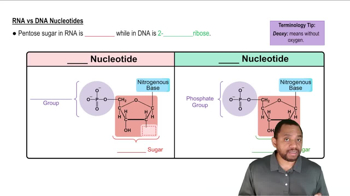
 1:34
1:34