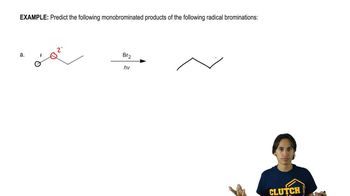
What is radical selectivity in the context of halogenation?
Radical selectivity is the ability for radicals to only halogenate the carbons with the most stable radical intermediates, typically favoring tertiary positions.
Why is fluorination considered highly nonselective in radical halogenation?
Fluorination is highly nonselective because it is extremely exothermic (ΔH = -432), causing it to react indiscriminately and sometimes explosively with all types of hydrogens.
What is the enthalpy value for radical chlorination, and what does it indicate about its selectivity?
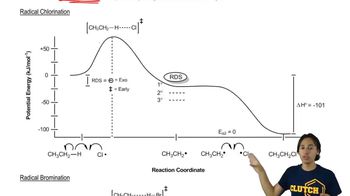
Chlorination has an enthalpy value of -101, making it exothermic and moderately selective, but it still produces a mixture of products due to its limited selectivity.
Which halogen is the most selective for radical halogenation and why?
Bromine is the most selective because its reaction is less exothermic (ΔH = -26), allowing it to preferentially halogenate the most stable radical intermediate, usually tertiary hydrogens.
Why is iodination generally not used in radical halogenation?
Iodination is not used because it is endothermic (ΔH = +53), making the reaction non-spontaneous and requiring energy input, so it does not proceed under normal conditions.
What type of product mixture is typically formed during radical chlorination of an alkane with different types of hydrogens?
Radical chlorination produces a mixture of products because it is only moderately selective and will halogenate primary, secondary, and tertiary hydrogens.
How does the Hammond postulate explain the difference in selectivity between bromination and chlorination?
The Hammond postulate states that the transition state resembles the species (reactant or product) closest in energy; for bromination, the transition state resembles the radical, making it more selective, while for chlorination, it resembles the starting material, making it less selective.
What is the nature of the rate-determining step in radical bromination compared to chlorination?
In bromination, the rate-determining step is endothermic, while in chlorination, it is exothermic, which affects the selectivity of each process.
Why does bromination favor the formation of the most stable radical intermediate?
Because the transition state in bromination closely resembles the radical, the stability of the radical significantly influences the reaction pathway, leading to high selectivity.
What happens to the activation energy when two radicals collide in the termination step of radical halogenation?
The activation energy for two radicals to collide and form a new bond is zero, meaning no energy input is required for this step.
What is meant by a racemic mixture in the context of radical halogenation of a chiral center?
A racemic mixture means that halogenation at a chiral center produces equal amounts of both enantiomers, resulting in a 50:50 mixture of the two possible stereoisomers.
How does the transition state in chlorination compare to the starting material, according to the Hammond postulate?
In chlorination, the transition state closely resembles the starting alkane, making the stability of the radical less important for selectivity.
What is the practical implication of the exothermicity of fluorination in organic synthesis?
The high exothermicity of fluorination makes it unpredictable and potentially explosive, so it is generally avoided in practical organic synthesis.
How does the selectivity of bromination benefit synthetic organic chemistry?
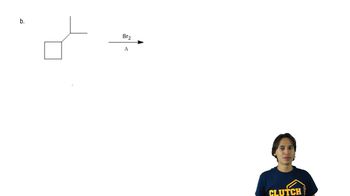
Bromination's high selectivity allows chemists to target specific hydrogens, especially tertiary ones, making it useful for controlled functionalization of alkanes.
What is an early versus a late transition state, and which halogenation reaction is associated with each?
An early transition state resembles the starting material (as in chlorination), while a late transition state resembles the radical intermediate (as in bromination), affecting the reaction's selectivity.
 Back
Back
 00:48
00:48