Skip to main content
Organic Chemistry
My Course
Learn
Exam Prep
AI Tutor
Study Guides
Textbook Solutions
Flashcards
Explore
Try the app
My Course
Learn
Exam Prep
AI Tutor
Study Guides
Textbook Solutions
Flashcards
Explore
Try the app
Back
Radical Synthesis definitions
You can tap to flip the card.
Radical Halogenation
You can tap to flip the card.
👆
Radical Halogenation
Transformation introducing a halogen atom to an alkane, selectively targeting tertiary positions for increased reactivity.
Track progress
Control buttons has been changed to "navigation" mode.
1/14
Related flashcards
Related practice
Recommended videos
Radical Synthesis quiz
Radical Synthesis
15 Terms
Allylic Bromination
11. Radical Reactions
8 problems
Topic
Johnny
11. Radical Reactions - Part 1 of 2
4 topics
11 problems
Chapter
Johnny
11. Radical Reactions - Part 2 of 2
5 topics
13 problems
Chapter
Johnny
04:12
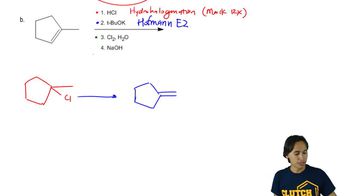
Predict the MAJOR product.
2524
views
14
rank
20
comments
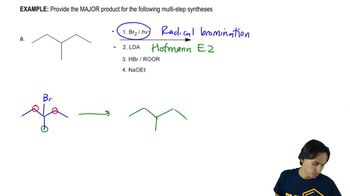
04:28
Predict the MAJOR product.
2022
views
18
rank
16
comments
Terms in this set (14)
Hide definitions
Radical Halogenation
Transformation introducing a halogen atom to an alkane, selectively targeting tertiary positions for increased reactivity.
Alkane
A saturated hydrocarbon serving as a starting material, notable for its chemical inertness and lack of functional groups.
Tertiary Position
A carbon atom bonded to three other carbons, often the most reactive site in radical halogenation due to stability.
LDA
A bulky, non-nucleophilic base used to promote elimination reactions, favoring less substituted alkene formation.
Hoffman Elimination
An E2 process using bulky bases to generate the least substituted alkene as the major product.
Bulky Base
A sterically hindered reagent that favors elimination over substitution, leading to less substituted alkenes.
Radical Hydrohalogenation
Addition of a hydrogen halide in the presence of peroxides, resulting in anti-Markovnikov alkyl halide formation.
Anti-Markovnikov Addition
A regioselective process where the halogen attaches to the less substituted carbon atom during hydrohalogenation.
Alkyl Halide
An organic molecule containing a halogen atom bonded to an sp3-hybridized carbon, serving as a key intermediate.
SN2 Reaction
A bimolecular nucleophilic substitution characterized by a single concerted step and backside attack.
Nucleophile
A species with a lone pair or negative charge that seeks electron-deficient centers, initiating substitution reactions.
Ether
A functional group featuring an oxygen atom bonded to two alkyl or aryl groups, often formed via SN2 reactions.
Peroxides
Initiators that generate radicals, enabling anti-Markovnikov addition during hydrohalogenation.
Primary Alkyl Halide
A halogenated compound where the halogen is attached to a carbon bonded to only one other carbon, favoring SN2.
 BackBack
 04:12
04:12