What is the purpose of radical halogenation in alkane synthesis?
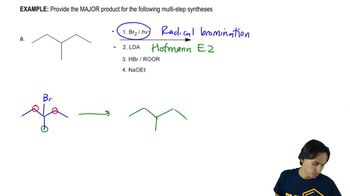
Radical halogenation introduces a halogen, such as bromine, to the most reactive (usually tertiary) position of an alkane, making it more reactive for further transformations.
Where does bromine attach during radical bromination of an alkane?
Bromine attaches to the tertiary carbon position during radical bromination because it is the most reactive site.
What type of elimination does LDA promote with a tertiary alkyl halide?
LDA, a bulky base, promotes Hoffman E2 elimination, which favors the formation of the less substituted alkene.
In a Hoffman E2 elimination, which alkene is the major product?
The major product is the less substituted alkene, formed by removing a beta hydrogen from the less hindered position.
What is the role of HBr and peroxides in the synthesis sequence?
HBr and peroxides perform radical hydrohalogenation, resulting in anti-Markovnikov addition of bromine to the alkene.
What does anti-Markovnikov addition mean in radical hydrohalogenation?
Anti-Markovnikov addition means the halogen (Br) adds to the less substituted carbon of the double bond.
Why is NaOEt considered a strong nucleophile in this sequence?
NaOEt is a strong nucleophile because it is negatively charged and can readily attack electrophilic carbons in SN2 reactions.
What type of reaction occurs when a primary alkyl halide reacts with NaOEt?
A primary alkyl halide reacts with NaOEt via an SN2 mechanism, resulting in nucleophilic substitution.
What is the final functional group formed after the SN2 reaction with NaOEt?
The final functional group is an ether, specifically an ethoxy group attached to the carbon chain.
Why is the SN2 mechanism favored for primary alkyl halides?
SN2 is favored for primary alkyl halides because there is minimal steric hindrance, allowing for efficient backside attack.
What is the significance of using a flowchart in determining reaction mechanisms?
A flowchart helps systematically determine the most likely reaction mechanism based on the nucleophile, base, and substrate structure.
How does the use of bulky bases like LDA affect the outcome of elimination reactions?
Bulky bases like LDA favor elimination at the least substituted position, leading to the Hoffman product.
What is the starting material in the described radical synthesis sequence?
The starting material is an alkane, which is initially unreactive and requires activation by radical halogenation.
How does radical synthesis transform alkanes into functionalized molecules?
Radical synthesis introduces functional groups through a sequence of halogenation, elimination, hydrohalogenation, and substitution reactions.
What does 'Et' stand for in the context of the final ether product?
'Et' stands for ethyl, indicating the presence of a two-carbon group attached as part of the ether.
 Back
Back
 04:12
04:12