Given a frequency histogram showing the number of students who scored within each -point interval on a test, which of the following statements is correct about the distribution of scores?
Table of contents
- 1. Intro to Stats and Collecting Data1h 14m
- 2. Describing Data with Tables and Graphs1h 55m
- 3. Describing Data Numerically2h 5m
- 4. Probability2h 16m
- 5. Binomial Distribution & Discrete Random Variables3h 6m
- 6. Normal Distribution and Continuous Random Variables2h 11m
- 7. Sampling Distributions & Confidence Intervals: Mean3h 23m
- Sampling Distribution of the Sample Mean and Central Limit Theorem19m
- Distribution of Sample Mean - Excel23m
- Introduction to Confidence Intervals15m
- Confidence Intervals for Population Mean1h 18m
- Determining the Minimum Sample Size Required12m
- Finding Probabilities and T Critical Values - Excel28m
- Confidence Intervals for Population Means - Excel25m
- 8. Sampling Distributions & Confidence Intervals: Proportion1h 25m
- 9. Hypothesis Testing for One Sample3h 29m
- 10. Hypothesis Testing for Two Samples4h 50m
- Two Proportions1h 13m
- Two Proportions Hypothesis Test - Excel28m
- Two Means - Unknown, Unequal Variance1h 3m
- Two Means - Unknown Variances Hypothesis Test - Excel12m
- Two Means - Unknown, Equal Variance15m
- Two Means - Unknown, Equal Variances Hypothesis Test - Excel9m
- Two Means - Known Variance12m
- Two Means - Sigma Known Hypothesis Test - Excel21m
- Two Means - Matched Pairs (Dependent Samples)42m
- Matched Pairs Hypothesis Test - Excel12m
- 11. Correlation1h 24m
- 12. Regression1h 50m
- 13. Chi-Square Tests & Goodness of Fit2h 21m
- 14. ANOVA1h 57m
2. Describing Data with Tables and Graphs
Histograms
Problem 2.2.2
Textbook Question
More IQ Scores The population of IQ scores of adults is normally distributed. If we obtain a voluntary response sample of 5000 of those IQ scores, will a histogram of the sample be bell-shaped?
Verified step by step guidance1
Understand the concept of a voluntary response sample: This type of sample is self-selected, meaning individuals choose to participate. It often leads to bias because those who respond may not represent the entire population.
Recall the properties of a normal distribution: A normal distribution is symmetric and bell-shaped, characterized by its mean and standard deviation.
Consider the Central Limit Theorem: This theorem states that the distribution of the sample mean will be approximately normal if the sample size is large enough, regardless of the population distribution. However, it applies to the distribution of sample means, not the distribution of individual sample values.
Evaluate the impact of sample bias: Since the sample is voluntary, it may not accurately reflect the population's normal distribution. This could affect the shape of the histogram, making it potentially not bell-shaped.
Conclude based on sample characteristics: Due to the voluntary nature of the sample, the histogram may not be bell-shaped even if the population distribution is normal. The sample may be skewed or have other biases that affect its shape.
Verified video answer for a similar problem:This video solution was recommended by our tutors as helpful for the problem above
Video duration:
2mPlay a video:
Was this helpful?
Key Concepts
Here are the essential concepts you must grasp in order to answer the question correctly.
Normal Distribution
A normal distribution is a continuous probability distribution characterized by a symmetric, bell-shaped curve. It is defined by its mean and standard deviation, where most of the data points cluster around the mean, and the probabilities for values taper off equally in both directions. Understanding this concept is crucial as it describes the population of IQ scores in the question.
Recommended video:
Guided course
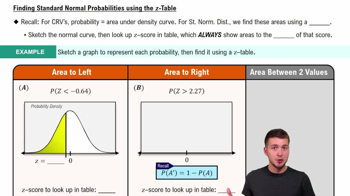
Finding Standard Normal Probabilities using z-Table
Voluntary Response Sample
A voluntary response sample is a type of non-probability sampling where participants self-select into the sample. This method often leads to bias because individuals with strong opinions or interests are more likely to participate, which may not accurately represent the entire population. Recognizing this bias is essential to evaluate whether the sample's histogram will reflect the population's normal distribution.
Recommended video:
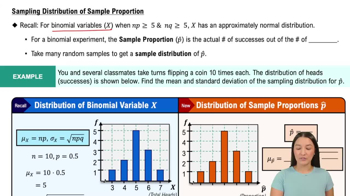
Sampling Distribution of Sample Proportion
Histogram
A histogram is a graphical representation of the distribution of numerical data, where data is grouped into bins or intervals. The height of each bar reflects the frequency of data points within each interval. In the context of the question, understanding how a histogram can visually represent the distribution of IQ scores helps assess whether the sample's distribution is bell-shaped like the population's normal distribution.
Recommended video:
Guided course
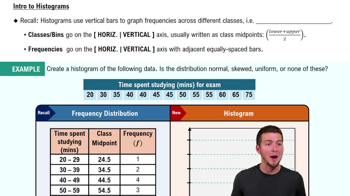
Intro to Histograms
Related Videos
Related Practice
Multiple Choice
9
views