Skip to main content
Introductory Statistics
My Course
Learn
Exam Prep
AI Tutor
Study Guides
Textbook Solutions
Flashcards
Explore
Try the app
My Course
Learn
Exam Prep
AI Tutor
Study Guides
Textbook Solutions
Flashcards
Explore
Try the app
Back
Basic Concepts of Probability definitions
You can tap to flip the card.
Probability
You can tap to flip the card.
👆
Probability
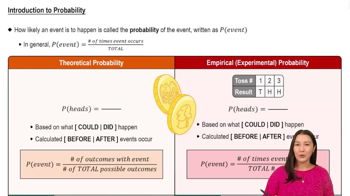
Quantifies how likely an event is to occur, often written as p(event) and calculated using mathematical formulas.
Track progress
Control buttons has been changed to "navigation" mode.
1/13
Related flashcards
Related practice
Recommended videos
Basic Concepts of Probability quiz #1
Basic Concepts of Probability
40 Terms
Basic Concepts of Probability quiz #2
Basic Concepts of Probability
40 Terms
Basic Concepts of Probability quiz #3
Basic Concepts of Probability
40 Terms
Basic Concepts of Probability
4. Probability
7 problems
Topic
Ernest
Complements
4. Probability
4 problems
Topic
Ernest
4. Probability - Part 1 of 3
3 topics
9 problems
Chapter
Ernest
4. Probability - Part 2 of 3
4 topics
12 problems
Chapter
Ernest
4. Probability - Part 3 of 3
2 topics
6 problems
Chapter
Ally
Guided course
5:37
Introduction to Probability
11746
views
454
rank
1
comments
Terms in this set (13)
Hide definitions
Probability
Quantifies how likely an event is to occur, often written as p(event) and calculated using mathematical formulas.
Event
Represents any outcome or occurrence, big or small, that can be analyzed for its likelihood.
Theoretical Probability
Determines likelihood based on possible outcomes before any trials, using mathematical reasoning.
Empirical Probability
Estimates likelihood using observed data from actual trials or experiments.
Sample Space
Lists all possible outcomes of an experiment, typically shown in curly brackets using set notation.
Outcome
Describes a single possible result from an experiment or random process.
Trial
Refers to one repetition or instance of an experiment, used to gather data for probability calculations.
Fraction
Expresses probability as a ratio of favorable outcomes to total possible outcomes.
Decimal
Represents probability values in numerical form, often used for reporting results.
Set Notation
Uses curly brackets to display all possible outcomes, aiding in visualizing sample spaces.
Sample Size
Indicates the number of trials or observations, affecting the accuracy of empirical probability.
Business Analytics
Applies probability concepts to interpret data and make informed decisions in commercial contexts.
Statistics
Utilizes probability to analyze, interpret, and draw conclusions from data.
 BackBack

 5:37
5:37