Statistics
My Course
Learn
Exam Prep
AI Tutor
Study Guides
Textbook Solutions
Flashcards
Explore
Try the app
My Course
Learn
Exam Prep
AI Tutor
Study Guides
Textbook Solutions
Flashcards
Explore
Try the app
Back
Standard Deviation definitions
You can tap to flip the card.
Standard Deviation
You can tap to flip the card.
👆
Standard Deviation
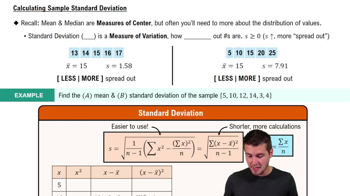
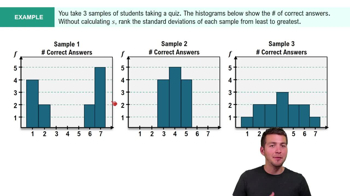
Quantifies how much data values differ from the mean, with higher values indicating greater spread.
Track progress
Control buttons has been changed to "navigation" mode.
1/15
Related flashcards
Related practice
Recommended videos
Standard Deviation quiz #1
Standard Deviation
40 Terms
Standard Deviation quiz #2
Standard Deviation
40 Terms
Standard Deviation quiz #3
Standard Deviation
40 Terms
Standard Deviation
3. Describing Data Numerically
7 problems
Topic

Jonathan
3. Describing Data Numerically
4 topics
11 problems
Chapter
David-Paige
Guided course
08:45
Calculating Standard Deviation
6824
views
136
rank
1
comments
Guided course
02:59
Calculating Standard Deviation Example 1
2822
views
135
rank
1
comments
Terms in this set (15)
Hide definitions
Standard Deviation
Quantifies how much data values differ from the mean, with higher values indicating greater spread.
Mean
Represents the central value of a dataset, calculated by summing all values and dividing by their count.
Measure of Variation
Describes the degree to which data values are dispersed or clustered within a dataset.
Sample
A subset of data points selected from a larger population, used for statistical calculations.
Population
The entire collection of data points or individuals relevant to a statistical study.
Sigma
A mathematical symbol indicating summation, commonly used to add up values or their squares.
X Bar
Symbolizes the mean of a sample, serving as a reference point for measuring spread.
N
Denotes the total number of data points in a sample or population.
S
Represents the standard deviation of a sample, reflecting variability around the mean.
Mu
Symbolizes the mean of a population, used in population-level statistical formulas.
Sigma Squared
Indicates the sum of squared data values, a key component in calculating variability.
Descriptive Statistics
Summarizes and presents data characteristics, including measures of center and spread.
Data Dispersion
Refers to the extent to which data values are spread out or clustered.
Equation
A mathematical expression used to compute statistical measures such as mean or standard deviation.
Practice Problem
An exercise designed to reinforce understanding of statistical concepts through calculation.