Ch. 2 - Descriptive Statistics
Larson - Elementary Statistics: Picturing the World 8th Edition
Larson8th EditionElementary Statistics: Picturing the WorldISBN: 9780137493470Not the one you use?Change textbook
Chapter 2, Problem 2.1.35

Constructing a Frequency Distribution and a Frequency Polygon In Exercises 35 and 36, construct a frequency distribution and a frequency polygon for the data set using the indicated number of classes. Describe any patterns.
Ages of the Presidents Number of classes: 7 Data set: Ages of the U.S. presidents at Inauguration (Source: The White House) 57 61 57 57 58 57 61 54 68 51 49 64 50 48 65 52 56 46 54 49 51 47 55 55 54 42 51 56 55 51 54 51 60 62 43 55 56 61 52 69 64 46 54 47 70 78

Verified step by step guidance
1
Step 1: Organize the data by listing all the ages of the U.S. presidents at inauguration. Identify the minimum and maximum ages in the data set to determine the range. The range is calculated as \(\text{Range} = \text{Maximum age} - \text{Minimum age}\).
Step 2: Determine the class width for the frequency distribution. Since the number of classes is given as 7, calculate the class width using the formula \(\text{Class width} = \frac{\text{Range}}{\text{Number of classes}}\). Round up the class width to a convenient number if necessary to cover the entire range.
Step 3: Construct the frequency distribution table by creating 7 classes starting from the minimum age, each with the calculated class width. For each class interval, count how many ages fall within that interval to find the frequency.
Step 4: To create the frequency polygon, first find the midpoints of each class interval. The midpoint of a class is calculated as \(\text{Midpoint} = \frac{\text{Lower class limit} + \text{Upper class limit}}{2}\). Plot these midpoints on the x-axis against their corresponding frequencies on the y-axis.
Step 5: Connect the plotted points with straight lines to form the frequency polygon. Finally, analyze the shape of the frequency polygon to describe any patterns such as symmetry, skewness, or peaks in the distribution.

Verified video answer for a similar problem:

This video solution was recommended by our tutors as helpful for the problem above.
Video duration:
9m
Was this helpful?

Key Concepts

Here are the essential concepts you must grasp in order to answer the question correctly.

Frequency Distribution

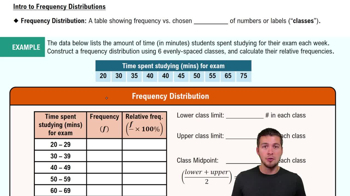
A frequency distribution organizes data into classes or intervals and shows how many data points fall into each class. It helps summarize large data sets by grouping values, making patterns easier to identify. For example, grouping ages into ranges and counting how many presidents fall into each range.
Recommended video:
Guided course
06:38
Intro to Frequency Distributions

Frequency Polygon

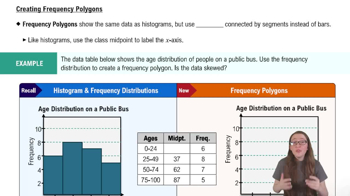
A frequency polygon is a graphical representation of a frequency distribution, created by plotting class midpoints against their frequencies and connecting the points with straight lines. It helps visualize the shape and trends of the data, such as peaks or gaps, and is useful for comparing distributions.
Recommended video:
04:41
Creating Frequency Polygons

Class Intervals and Number of Classes

Class intervals divide the data range into equal segments, and the number of classes determines how many intervals to create. Choosing an appropriate number of classes (here, 7) balances detail and clarity, avoiding too many or too few groups, which affects the accuracy and readability of the frequency distribution and polygon.
Recommended video:
Guided course
09:00
Prediction Intervals