
Ch. 2 - Descriptive Statistics
Larson - Elementary Statistics: Picturing the World 8th Edition
Larson8th EditionElementary Statistics: Picturing the WorldISBN: 9780137493470Not the one you use?Change textbook
Chapter 2, Problem 2.5.6

Building Basic Skills and Vocabulary


Describe the relationship between quartiles and percentiles.

Verified step by step guidance
1
Understand the concept of percentiles: Percentiles divide a dataset into 100 equal parts, where each percentile represents 1% of the data. For example, the 25th percentile indicates the value below which 25% of the data falls.
Understand the concept of quartiles: Quartiles divide a dataset into 4 equal parts, where each quartile represents 25% of the data. The quartiles are Q1 (25th percentile), Q2 (50th percentile, also known as the median), and Q3 (75th percentile).
Recognize the relationship between quartiles and percentiles: Quartiles are specific percentiles. Q1 corresponds to the 25th percentile, Q2 corresponds to the 50th percentile, and Q3 corresponds to the 75th percentile.
Visualize the relationship: Imagine a dataset sorted in ascending order. Percentiles provide finer divisions (1% increments), while quartiles provide broader divisions (25% increments). Quartiles are essentially key markers within the percentile scale.
Apply the relationship in practice: When analyzing data, quartiles are often used to summarize the spread and central tendency of the dataset, while percentiles are used for more detailed comparisons or rankings within the data.

Verified video answer for a similar problem:

This video solution was recommended by our tutors as helpful for the problem above.
Video duration:
59s
Was this helpful?

Key Concepts

Here are the essential concepts you must grasp in order to answer the question correctly.

Quartiles

Quartiles are values that divide a dataset into four equal parts, each containing 25% of the data. The first quartile (Q1) marks the 25th percentile, the second quartile (Q2) is the median or 50th percentile, and the third quartile (Q3) represents the 75th percentile. Understanding quartiles helps in analyzing the spread and central tendency of data.
Recommended video:
Guided course
04:51
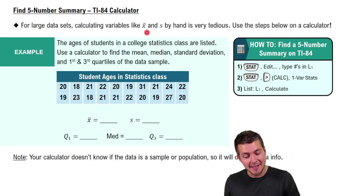
Find 5-Number Summary - TI-84 Calculator

Percentiles

Percentiles are measures that indicate the relative standing of a value within a dataset, dividing the data into 100 equal parts. For example, the 30th percentile is the value below which 30% of the data falls. Percentiles are useful for comparing scores or measurements across different datasets, providing insights into distribution and ranking.

Relationship between Quartiles and Percentiles

The relationship between quartiles and percentiles is that quartiles are specific percentiles. Each quartile corresponds to a specific percentile: Q1 is the 25th percentile, Q2 is the 50th percentile, and Q3 is the 75th percentile. This connection allows for a deeper understanding of data distribution, as quartiles provide a more concise summary of the data's spread while percentiles offer a more granular view.
Recommended video:
Guided course
03:50
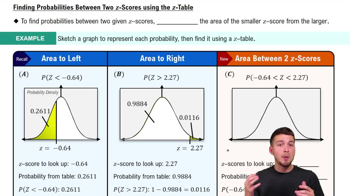
Probabilities Between Two Values
Related Practice
Textbook Question

Using and Interpreting Concepts


Finding and Discussing the Mean, Median, and Mode In Exercises 17–34, find the mean, the median, and the mode of the data, if possible. If any measure cannot be found or does not represent the center of the data, explain why.


Prices (in dollars) of Flights from Chicago to Alanta

" style="" width="235">

64
views
Textbook Question

Using and Interpreting Concepts


Graphical Analysis In Exercises 13–16, give three observations that can be made from the graph.


119
views
Textbook Question

Phone Screen Sizes Display the data below in a dot plot. Describe the differences in how the stem-and-leaf plot and the dot plot show patterns in the data.

145
views
Textbook Question

Graphing Data Sets In Exercises 17–32, organize the data using the indicated type of graph. Describe any patterns.


Life Spans of Houseflies Use a dot plot to display the data, which represent the life spans (in days) of 30 houseflies. 

9 9 4 11 10 5 13 9 7 11 6 8 14 10 6 

10 10 7 14 11 7 8 6 13 10 14 14 8 13 10

187
views
Textbook Question

Using and Interpreting Concepts


Finding and Discussing the Mean, Median, and Mode In Exercises 17–34, find the mean, the median, and the mode of the data, if possible. If any measure cannot be found or does not represent the center of the data, explain why.


Power Failures The durations (in minutes) of power failures at a residence in the last 10 years

18 26 45 75 125 80 33

40 44 49 89 80 96 125

12 61 31 63 103 28 19

99
views
Textbook Question

Constructing a Frequency Distribution and a Frequency Polygon In Exercises 35 and 36, construct a frequency distribution and a frequency polygon for the data set using the indicated number of classes. Describe any patterns.

Ages of the Presidents Number of classes: 7 Data set: Ages of the U.S. presidents at Inauguration (Source: The White House) 57 61 57 57 58 57 61 54 68 51 49 64 50 48 65 52 56 46 54 49 51 47 55 55 54 42 51 56 55 51 54 51 60 62 43 55 56 61 52 69 64 46 54 47 70 78

94
views