Ch. 2 - Exploring Data with Tables and Graphs
Triola - Elementary Statistics 14th Edition
Triola14th EditionElementary StatisticsISBN: 9780137366446Not the one you use?Change textbook
Chapter 2, Problem 2.1.32

Exercises 29–34 involve large sets of data, so technology should be used. Complete lists of the data are not listed in Appendix B, but they can be downloaded from the website TriolaStats.com. Use the indicated data and construct the frequency distribution.


Diastolic Blood Pressure Use the diastolic blood pressures of the 300 subjects included in Data Set 1 “Body Data.” Use a class width of 15 mm Hg and begin with a lower class limit of 40 mm Hg. Does the frequency distribution appear to be a normal distribution?

Verified step by step guidance
1
Step 1: Understand the problem. You are tasked with constructing a frequency distribution for the diastolic blood pressures of 300 subjects. The class width is given as 15 mm Hg, and the starting lower class limit is 40 mm Hg. Additionally, you need to assess whether the resulting frequency distribution resembles a normal distribution.
Step 2: Define the class intervals. Start with the lower class limit of 40 mm Hg. Add the class width (15 mm Hg) successively to determine the upper limit of each class and the lower limit of the next class. For example, the first class would be 40–54 mm Hg, the second class would be 55–69 mm Hg, and so on. Continue this process until all data values are covered.
Step 3: Tally the data. Using the diastolic blood pressure data from Data Set 1, count how many data points fall into each class interval. This will give you the frequency for each class. Use technology (e.g., Excel, statistical software, or a graphing calculator) to efficiently sort and count the data.
Step 4: Construct the frequency distribution table. Create a table with three columns: Class Interval, Frequency, and Relative Frequency (optional). Fill in the class intervals and their corresponding frequencies. If desired, calculate the relative frequency for each class by dividing the frequency of the class by the total number of data points (300).
Step 5: Assess normality. Plot the frequency distribution as a histogram. Check if the histogram has a bell-shaped curve, which is characteristic of a normal distribution. Look for symmetry around the center and tapering tails. If the distribution is approximately symmetric and bell-shaped, it may resemble a normal distribution.

Verified video answer for a similar problem:

This video solution was recommended by our tutors as helpful for the problem above.
Video duration:
5m
Was this helpful?

Key Concepts

Here are the essential concepts you must grasp in order to answer the question correctly.

Frequency Distribution

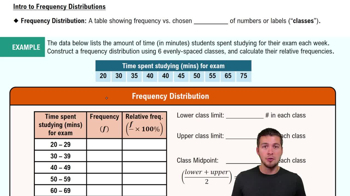
A frequency distribution is a summary of how often each value occurs in a dataset. It organizes data into classes or intervals, showing the number of observations within each class. This helps in visualizing the distribution of data points and identifying patterns, such as skewness or modality, which are essential for further statistical analysis.
Recommended video:
Guided course
06:38
Intro to Frequency Distributions

Class Width

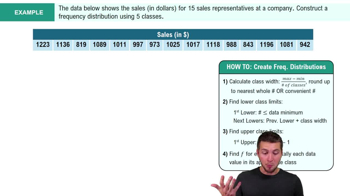
Class width refers to the range of values that each class in a frequency distribution covers. It is calculated by subtracting the lower limit of a class from its upper limit. Choosing an appropriate class width is crucial, as it affects the granularity of the data representation and can influence the interpretation of the distribution's shape.
Recommended video:
Guided course
05:18
How to Create Frequency Distributions Example 2

Normal Distribution

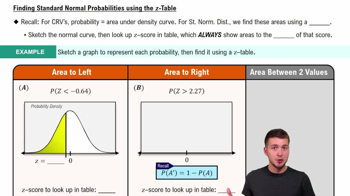
A normal distribution is a probability distribution that is symmetric about the mean, showing that data near the mean are more frequent in occurrence than data far from the mean. It is characterized by its bell-shaped curve. Identifying whether a frequency distribution approximates a normal distribution is important for applying various statistical methods and tests that assume normality.
Recommended video:
Guided course
09:47
Finding Standard Normal Probabilities using z-Table
Related Practice
Textbook Question

In Exercises 11 and 12 construct the Pareto chart.


Box Office Boffo Recent annual gross revenue (millions of dollars) for the leading movie studios are as follows: 20th Century Fox (1082), Buena Vista (3092), Paramount (757), Sony/Columbia (1304), Universal (1772), Warner Brothers (1941). Are these data likely to be reasonably accurate?

155
views
Textbook Question

Presidents Listed below are the ages (years) of presidents of the United States at the times of their first inaugurations (from Data Set 22 “Presidents” in Appendix B). Presidents who took office as a result of an assassination or resignation are not included. The data are current as of this writing. Use these ages to construct a frequency distribution. Use a class width of 5 years and begin with a lower class limit of 40 years. Do the ages appear to have a normal distribution?

244
views
Textbook Question

Hershey Kisses Refer to Data Set 38 “Candies” and use the weights (grams) of Hershey’s Kisses. Begin with a lower class limit of 4.300 g and use a class width of 0.100 g. Does this distribution appear to be a normal distribution?

144
views
Textbook Question

In Exercises 5 and 6, construct the dotplot.


Pulse Rates Listed below are pulse rates (beats per minute) of females selected from Data Set 1 “Body Data” in Appendix B. All of those pulse rates are even numbers. Is there a pulse rate that appears to be an outlier? What is its value?


142
views
Textbook Question

In Exercises 9–18, construct the histograms and answer the given questions.


Tornadoes Use the frequency distribution from Exercise 16 in Section 2-1 to construct a histogram. Does the histogram appear to be skewed? If so, identify the type of skewness.

134
views
Textbook Question

In Exercises 9–18, construct the histograms and answer the given questions.


Hershey’s Kisses Use the frequency distribution from Exercise 20 in Section 2-1 to construct a histogram. In using a strict interpretation of the criteria for being a normal distribution, does the histogram appear to depict data from a population with a normal distribution?

145
views