Ch. 4 - Graphs of the Circular Functions
Lial - Trigonometry 12th Edition
Lial12th EditionTrigonometryISBN: 9780136552161Not the one you use?Change textbook
Chapter 5, Problem 16

Match each function with its graph in choices A–I. (One choice will not be used.)
y = -1 + cos x


A. <IMAGE> B. <IMAGE> C. <IMAGE>


D. <IMAGE> E. <IMAGE> F. <IMAGE>


G. <IMAGE> H. <IMAGE> I. <IMAGE>

Verified step by step guidance
1
Identify the base function in the given equation: here, it is the cosine function, \(\cos x\).
Note the transformation applied to the base function: the function is shifted vertically by \(-1\), so the graph of \(y = \cos x\) is moved down by 1 unit.
Recall the key characteristics of \(y = \cos x\): it has a maximum value of 1, a minimum value of -1, and a midline at \(y=0\). After the vertical shift, the new midline will be at \(y = -1\).
Analyze the amplitude and period: the amplitude remains 1 (since there is no coefficient multiplying \(\cos x\)), and the period remains \(2\pi\).
Match the graph that shows a cosine wave with its midline at \(y = -1\), maximum at 0, minimum at \(-2\), and the usual cosine wave shape starting at a maximum point when \(x=0\).

Verified video answer for a similar problem:

This video solution was recommended by our tutors as helpful for the problem above.
Was this helpful?

Key Concepts

Here are the essential concepts you must grasp in order to answer the question correctly.

Graphing Transformations of Trigonometric Functions

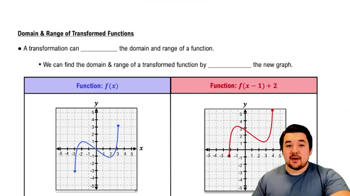
Understanding how vertical shifts, reflections, and stretches affect the graph of trigonometric functions is essential. For example, y = -1 + cos x represents a cosine graph shifted down by 1 unit. Recognizing these transformations helps match the function to its correct graph.
Recommended video:
4:22
Domain and Range of Function Transformations

Properties of the Cosine Function

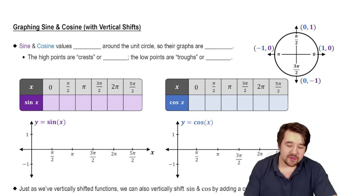
The cosine function has a period of 2π, an amplitude of 1, and ranges between -1 and 1. Knowing its shape, maxima, minima, and zeros allows you to identify its graph and distinguish it from sine or other trigonometric functions.
Recommended video:
5:53
Graph of Sine and Cosine Function

Function and Graph Matching Techniques

Matching functions to graphs involves analyzing key features such as amplitude, period, phase shift, and vertical shift. Comparing these features systematically enables accurate identification of the correct graph among multiple choices.
Recommended video:
5:53
Graph of Sine and Cosine Function