Ch. 1 - Trigonometric Functions
Lial - Trigonometry 12th Edition
Lial12th EditionTrigonometryISBN: 9780136552161Not the one you use?Change textbook
Chapter 2, Problem 28

Find the measure of each marked angle. See Example 2.

Verified step by step guidance
1
Identify all the given angles and the relationships between them in the diagram (such as complementary, supplementary, vertical, or corresponding angles).
Recall the definitions: complementary angles add up to \(180^\circ\), supplementary angles add up to \(180^\circ\), and vertical angles are equal.
Set up equations based on these relationships. For example, if two angles are supplementary, write \(\text{angle}_1 + \text{angle}_2 = 180^\circ\).
Use algebraic methods to solve the equations for the unknown angles. This may involve substitution or combining like terms.
Once you have expressions for the unknown angles, write down their measures in degrees, ensuring they satisfy all given conditions.

Verified video answer for a similar problem:

This video solution was recommended by our tutors as helpful for the problem above.
Video duration:
2m
Was this helpful?

Key Concepts

Here are the essential concepts you must grasp in order to answer the question correctly.

Angle Measurement Units

Understanding how angles are measured, typically in degrees or radians, is fundamental. Degrees divide a circle into 360 parts, while radians relate the angle to the radius of a circle. Knowing how to interpret and convert between these units is essential for solving angle problems.
Recommended video:
5:31
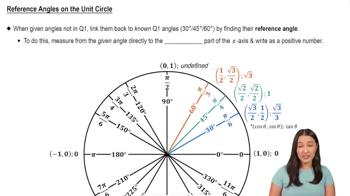
Reference Angles on the Unit Circle

Properties of Angles

Familiarity with angle properties such as complementary, supplementary, vertical, and adjacent angles helps in determining unknown angle measures. For example, supplementary angles sum to 180°, and vertical angles are equal, which are often used to find missing angles in geometric figures.
Recommended video:
2:20
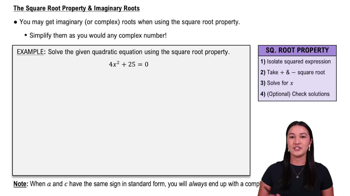
Imaginary Roots with the Square Root Property

Use of Trigonometric Ratios

Trigonometric ratios (sine, cosine, tangent) relate the angles of a triangle to the lengths of its sides. These ratios are crucial for calculating unknown angles when side lengths are known, especially in right triangles, enabling precise angle measurement.
Recommended video:
04:42
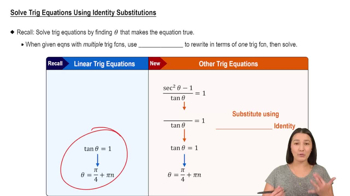
Solve Trig Equations Using Identity Substitutions