Skip to main content
Trigonometry
My Course
Learn
Exam Prep
AI Tutor
Study Guides
Textbook Solutions
Flashcards
Explore
Try the app
My Course
Learn
Exam Prep
AI Tutor
Study Guides
Textbook Solutions
Flashcards
Explore
Try the app
Back
Introduction to Trigonometric Identities definitions
You can tap to flip the card.
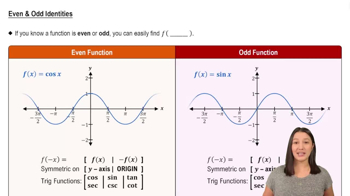
Even Function
You can tap to flip the card.
👆
Even Function
Symmetry about the y-axis; output remains unchanged when input sign is flipped.
Track progress
Control buttons has been changed to "navigation" mode.
1/15
Related flashcards
Related practice
Recommended videos
Introduction to Trigonometric Identities quiz #1
Introduction to Trigonometric Identities
10 Terms
Introduction to Trigonometric Identities
6. Trigonometric Identities and More Equations
7 problems
Topic
Patrick
Sum and Difference Identities
6. Trigonometric Identities and More Equations
7 problems
Topic
Patrick
6. Trigonometric Identities and More Equations
4 topics
12 problems
Chapter
Patrick
Guided course
6:36
Simplifying Trig Expressions
1964
views
17
rank
Guided course
06:19
Even and Odd Identities
2780
views
42
rank
2
comments
Guided course
5:18
Example 4
1446
views
15
rank
Terms in this set (15)
Hide definitions
Even Function
Symmetry about the y-axis; output remains unchanged when input sign is flipped.
Odd Function
Symmetry about the origin; output sign reverses when input sign is flipped.
Cosine
Trigonometric function classified as even; value unchanged for negative angles.
Sine
Trigonometric function classified as odd; value negated for negative angles.
Tangent
Trigonometric function classified as odd; value negated for negative angles.
Secant
Reciprocal of cosine; classified as even, unchanged for negative angles.
Cosecant
Reciprocal of sine; classified as odd, negated for negative angles.
Cotangent
Reciprocal of tangent; classified as odd, negated for negative angles.
Identity
Equation true for all possible values of its variable, used to simplify expressions.
Even-Odd Identity
Rule for replacing trigonometric functions of negative angles based on function symmetry.
Pythagorean Identity
Relationship among squared sine, cosine, tangent, secant, cotangent, and cosecant values.
Argument
Input value inside parentheses of a trigonometric function, often an angle.
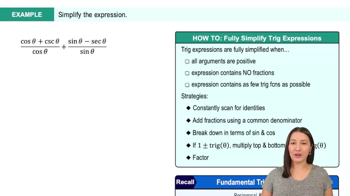
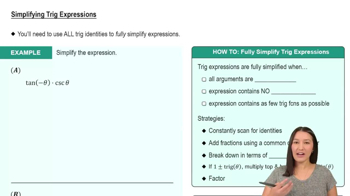
Simplification
Process of rewriting expressions with positive arguments, fewer functions, and no fractions.
Verification
Demonstration that both sides of a trigonometric equation are equal using identities.
Unit Circle
Circle with radius one, used to define trigonometric function values for specific angles.
 BackBack
 6:36
6:36