Skip to main content
Trigonometry
My Course
Learn
Exam Prep
AI Tutor
Study Guides
Textbook Solutions
Flashcards
Explore
Try the app
My Course
Learn
Exam Prep
AI Tutor
Study Guides
Textbook Solutions
Flashcards
Explore
Try the app
Back
Trigonometric Functions on the Unit Circle definitions
You can tap to flip the card.
Unit Circle
You can tap to flip the card.
👆
Unit Circle
A circle with radius 1 centered at the origin, used to relate angles to coordinates and trigonometric values.
Track progress
Control buttons has been changed to "navigation" mode.
1/15
Related flashcards
Related practice
Recommended videos
Trigonometric Functions on the Unit Circle quiz #1
Trigonometric Functions on the Unit Circle
38 Terms
Trigonometric Functions on the Unit Circle
3. Unit Circle
7 problems
Topic
Patrick
Common Values of Sine, Cosine, & Tangent
3. Unit Circle
7 problems
Topic
Patrick
3. Unit Circle
5 topics
14 problems
Chapter
Patrick
Guided course
6:34
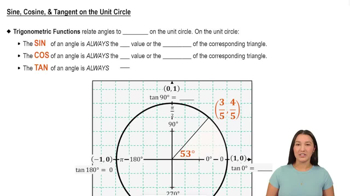
Sine, Cosine, & Tangent on the Unit Circle
2149
views
35
rank
Terms in this set (15)
Hide definitions
Unit Circle
A circle with radius 1 centered at the origin, used to relate angles to coordinates and trigonometric values.
Trigonometric Functions
Mathematical relationships connecting angles to coordinates, specifically using sine, cosine, and tangent.
Sine
The y-coordinate of a point on the unit circle corresponding to a given angle, representing triangle height.
Cosine
The x-coordinate of a point on the unit circle for a given angle, representing triangle base.
Tangent
A value found by dividing the y-coordinate by the x-coordinate for a given angle on the unit circle.
Right Triangle
A geometric figure formed by connecting the origin, a point on the unit circle, and the x-axis.
Hypotenuse
The side of a right triangle on the unit circle, always equal to the radius, which is 1.
Quadrant
One of four regions in the coordinate plane, affecting the sign of trigonometric values.
Ordered Pair
A set of x and y values representing a point on the unit circle, used to determine trig values.
Undefined Value
A result from dividing by zero, such as tangent at 90 or 270 degrees, which cannot be calculated.
Reciprocal
A value obtained by swapping the numerator and denominator, used in fraction division for tangent.
Negative Value
A trig result occurring in certain quadrants, reflecting the sign of coordinates on the unit circle.
Degree Measure
A way to specify angles, such as 0, 60, 90, 180, 217, or 270, for locating points on the unit circle.
Base
The horizontal side of a right triangle on the unit circle, matching the x-coordinate.
Height
The vertical side of a right triangle on the unit circle, matching the y-coordinate.
 BackBack
 6:34
6:34