
Textbook Question
If θ is an acute angle and cos θ = 1/3, find csc (𝜋/2 - θ).
915
views

 Verified step by step guidance
 5:31
5:31
 04:46
04:46 6:36
6:36If θ is an acute angle and cos θ = 1/3, find csc (𝜋/2 - θ).
In Exercises 71–74, find the length of the arc on a circle of radius r intercepted by a central angle θ. Express arc length in terms of 𝜋. Then round your answer to two decimal places. Radius, r: 8 feet Central Angle, θ: θ = 225°
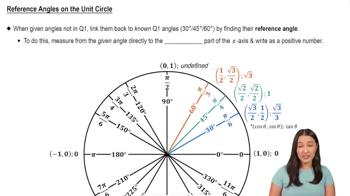
In Exercises 5–18, the unit circle has been divided into twelve equal arcs, corresponding to t-values of
0, 𝜋, 𝜋, 𝜋, 2𝜋, 5𝜋, 𝜋, 7𝜋, 4𝜋, 3𝜋, 5𝜋, 11𝜋, and 2𝜋.
6 3 2 3 6 6 3 2 3 6
Use the (x,y) coordinates in the figure to find the value of each trigonometric function at the indicated real number, t, or state that the expression is undefined.
<IMAGE>
In Exercises 11–18, continue to refer to the figure at the bottom of the previous page.
sec 3𝜋/2
In Exercises 61–86, use reference angles to find the exact value of each expression. Do not use a calculator. sec 240°
In Exercises 61–86, use reference angles to find the exact value of each expression. Do not use a calculator. csc(7𝜋/6)
In Exercises 35–60, find the reference angle for each angle. 553°