Ch. 1 - Angles and the Trigonometric Functions
Blitzer - Trigonometry 3rd Edition
Blitzer3rd EditionTrigonometryISBN: 9780137316601Not the one you use?Change textbook
Chapter 1, Problem 1.3.57

In Exercises 35–60, find the reference angle for each angle. - 11𝜋 / 4

Verified step by step guidance
1
Identify the given angle: \(\frac{11\pi}{4}\) radians.
Since the angle is greater than \(2\pi\), subtract multiples of \(2\pi\) to find a coterminal angle between \(0\) and \(2\pi\). Calculate \(\frac{11\pi}{4} - 2\pi\).
Simplify the subtraction: \(2\pi\) can be written as \(\frac{8\pi}{4}\), so subtract \(\frac{8\pi}{4}\) from \(\frac{11\pi}{4}\) to get the coterminal angle.
Determine the quadrant of the coterminal angle by comparing it to \(\frac{\pi}{2}\), \(\pi\), and \(\frac{3\pi}{2}\).
Find the reference angle by calculating the acute angle between the coterminal angle and the nearest x-axis (either \(0\), \(\pi\), or \(2\pi\)), using the formula for reference angles depending on the quadrant.

Verified video answer for a similar problem:

This video solution was recommended by our tutors as helpful for the problem above.
Video duration:
2m

Key Concepts

Here are the essential concepts you must grasp in order to answer the question correctly.

Reference Angle

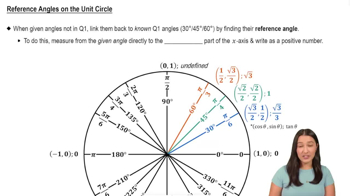
A reference angle is the acute angle formed between the terminal side of a given angle and the x-axis. It is always positive and less than or equal to 90°, used to simplify trigonometric calculations by relating any angle to an angle in the first quadrant.
Recommended video:
Guided course
5:31
Reference Angles on the Unit Circle

Angle Measurement in Radians

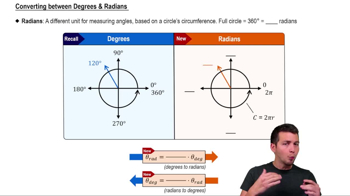
Angles can be measured in radians, where 2π radians equal 360 degrees. Understanding how to convert and interpret angles in radians is essential, especially when dealing with multiples of π, as it helps in locating the angle on the unit circle.
Recommended video:
Guided course
5:04
Converting between Degrees & Radians

Coterminal Angles

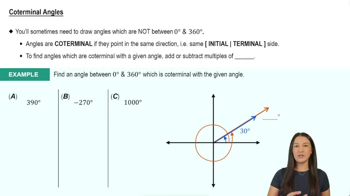
Coterminal angles differ by full rotations of 2π radians but share the same terminal side. Finding coterminal angles helps reduce large or negative angles to an equivalent angle between 0 and 2π, which is useful for determining the reference angle.
Recommended video:
Guided course
04:46
Coterminal Angles