Here are the essential concepts you must grasp in order to answer the question correctly.
Simple Harmonic Motion (SHM)
Simple Harmonic Motion is a type of periodic motion where an object moves back and forth around an equilibrium position. The motion can be described by a sinusoidal function, such as sine or cosine, which indicates the object's displacement over time. In this context, the equation d = 20 cos(π/4 t) represents the displacement of the object as a function of time, with the amplitude and frequency determining the characteristics of the motion.
Recommended video:
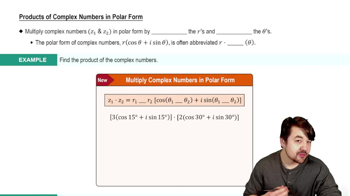
Products of Complex Numbers in Polar Form
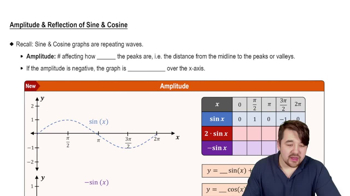
Maximum Displacement (Amplitude)
The maximum displacement, also known as amplitude, is the greatest distance the object moves from its equilibrium position during its motion. In the equation d = 20 cos(π/4 t), the amplitude is represented by the coefficient of the cosine function, which is 20 cm. This value indicates that the object will oscillate between +20 cm and -20 cm from the center position.
Recommended video:
Amplitude and Reflection of Sine and Cosine
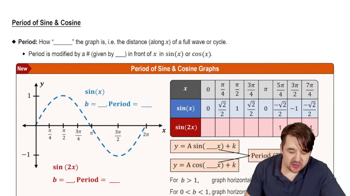
Frequency and Period
Frequency refers to the number of cycles an object completes in one second, while the period is the time taken to complete one full cycle. The frequency can be derived from the angular frequency in the equation, which is related to the coefficient of t in the cosine function. In this case, the angular frequency is π/4, leading to a frequency of 2/π Hz and a period of 4/π seconds, indicating how quickly the object oscillates.
Recommended video:
Period of Sine and Cosine Functions


 Verified step by step guidance
 04:46
04:46