Pearson+ LogoPearson+ Logo
Ch. 5 - Complex Numbers, Polar Coordinates and Parametric Equations
Blitzer - Trigonometry 3rd Edition
Blitzer3rd EditionTrigonometryISBN: 9780137316601Not the one you use?Change textbook
Chapter 5, Problem 9

In Exercises 7–12, test for symmetry with respect to a. the polar axis. b. the line θ=π2. c. the pole.r = 4 + 3 cos θ

Verified step by step guidance
1
**Step 1:** To test for symmetry with respect to the polar axis, replace \( \theta \) with \( -\theta \) in the equation \( r = 4 + 3 \cos \theta \). Simplify the expression to see if it results in the original equation.
**Step 2:** To test for symmetry with respect to the line \( \theta = \frac{\pi}{2} \), replace \( \theta \) with \( \pi - \theta \) in the equation \( r = 4 + 3 \cos \theta \). Simplify the expression to check if it results in the original equation.
**Step 3:** To test for symmetry with respect to the pole, replace \( r \) with \( -r \) in the equation \( r = 4 + 3 \cos \theta \). Simplify the expression to see if it results in the original equation.
**Step 4:** Analyze the results from each symmetry test. If the modified equation matches the original equation in any of the tests, the graph is symmetric with respect to that axis, line, or point.
**Step 5:** Summarize the findings for each symmetry test, indicating whether the graph is symmetric with respect to the polar axis, the line \( \theta = \frac{\pi}{2} \), or the pole.

Verified video answer for a similar problem:

This video solution was recommended by our tutors as helpful for the problem above.
Video duration:
5m
Was this helpful?

Key Concepts

Here are the essential concepts you must grasp in order to answer the question correctly.

Symmetry in Polar Coordinates

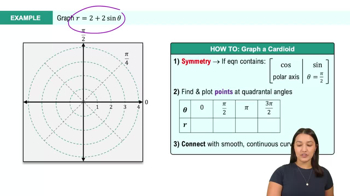
In polar coordinates, symmetry can be analyzed with respect to the polar axis, the line θ=π/2, and the pole. A graph is symmetric about the polar axis if replacing θ with -θ yields the same equation. Symmetry about the line θ=π/2 occurs if replacing θ with π-θ results in the same equation, while symmetry about the pole is confirmed if replacing r with -r and θ with θ+π gives the same equation.
Recommended video:
05:32
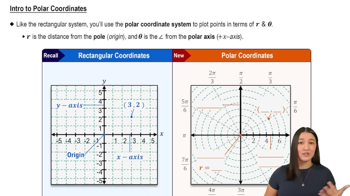
Intro to Polar Coordinates

Polar Axis

The polar axis is the horizontal line in polar coordinates, equivalent to the positive x-axis in Cartesian coordinates. To test for symmetry with respect to the polar axis, one substitutes -θ into the polar equation. If the resulting equation is equivalent to the original, the graph exhibits symmetry about the polar axis, indicating that it is a mirror image across this line.
Recommended video:
05:32
Intro to Polar Coordinates

The Pole

The pole in polar coordinates is the origin point, represented by r=0. To check for symmetry about the pole, one replaces r with -r and θ with θ+π in the polar equation. If the modified equation remains unchanged, the graph is symmetric about the pole, suggesting that points on the graph have corresponding points directly opposite them through the origin.
Recommended video:
05:32
Intro to Polar Coordinates