Here are the essential concepts you must grasp in order to answer the question correctly.
Unit Circle
The unit circle is a circle with a radius of one centered at the origin of a coordinate plane. It is fundamental in trigonometry as it provides a geometric interpretation of the sine, cosine, and tangent functions. The coordinates of points on the unit circle correspond to the cosine and sine values of angles measured in radians, making it essential for finding exact function values like sin(π/3).
Recommended video:
Introduction to the Unit Circle
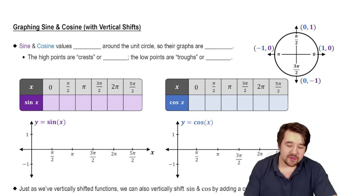
Sine Function
The sine function, denoted as sin(θ), is a fundamental trigonometric function that relates an angle θ to the ratio of the length of the opposite side to the hypotenuse in a right triangle. In the context of the unit circle, sin(θ) represents the y-coordinate of the point on the circle corresponding to the angle θ. Understanding the sine function is crucial for calculating exact values for specific angles, such as sin(π/3).
Recommended video:
Graph of Sine and Cosine Function
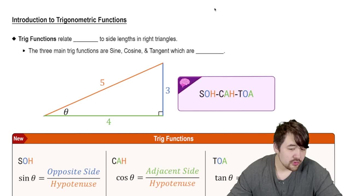
Exact Values of Trigonometric Functions
Exact values of trigonometric functions refer to specific, simplified numerical values for common angles, such as 0, π/6, π/4, π/3, and π/2. These values can be derived from the unit circle or special triangles, such as the 30-60-90 triangle for sin(π/3). Knowing these exact values allows for quick calculations and a deeper understanding of trigonometric relationships.
Recommended video:
Introduction to Trigonometric Functions



 Verified step by step guidance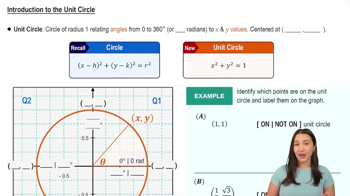
 06:11
06:11