An object in simple harmonic motion has position function s(t), in inches, from an equilibrium point, as follows, where t is time in seconds. 𝒮(t) = 5 cos 2t What is the amplitude of this motion?
Verified step by step guidance
1
Identify the general form of the cosine function for simple harmonic motion, which is \( s(t) = A \cos(Bt + C) + D \).
Recognize that in the given function \( \mathcal{S}(t) = 5 \cos(2t) \), the amplitude \( A \) is the coefficient of the cosine function.
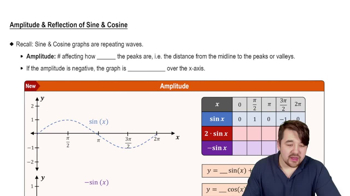
Understand that the amplitude represents the maximum displacement from the equilibrium position.
In the function \( \mathcal{S}(t) = 5 \cos(2t) \), the amplitude \( A \) is the absolute value of the coefficient of the cosine term.
Conclude that the amplitude of the motion is the absolute value of 5.
Verified video answer for a similar problem:
This video solution was recommended by our tutors as helpful for the problem above.
Play a video:
Was this helpful?
Key Concepts
Here are the essential concepts you must grasp in order to answer the question correctly.
Simple Harmonic Motion (SHM)
Simple Harmonic Motion is a type of periodic motion where an object oscillates around an equilibrium position. The motion is characterized by a restoring force proportional to the displacement from the equilibrium, leading to sinusoidal functions in its position, velocity, and acceleration. In SHM, the position function can typically be expressed in terms of sine or cosine functions.
Amplitude is a key characteristic of oscillatory motion, representing the maximum displacement of an object from its equilibrium position. In the context of the position function s(t) = A cos(ωt), the amplitude A indicates how far the object moves from the center point during its motion. For the given function, the amplitude is the coefficient of the cosine term.
The cosine function is a fundamental trigonometric function that describes the relationship between the angle and the adjacent side of a right triangle. In the context of SHM, the cosine function is used to model the position of an oscillating object over time. The general form s(t) = A cos(ωt) shows how the position varies with time, where A is the amplitude and ω is the angular frequency.