
Textbook Question
To find the distance AB across a river, a surveyor laid off a distance BC = 354 m on one side of the river. It is found that B = 112° 10' and C = 15° 20'. Find AB. See the figure.
<IMAGE>
1044
views

 Verified step by step guidance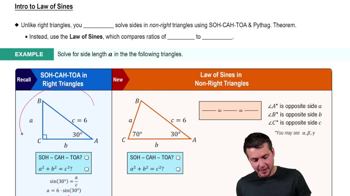
 4:27
4:27
 9:50
9:50 5:35
5:35To find the distance AB across a river, a surveyor laid off a distance BC = 354 m on one side of the river. It is found that B = 112° 10' and C = 15° 20'. Find AB. See the figure.
<IMAGE>
CONCEPT PREVIEW Refer to vectors a through h below. Make a copy or a sketch of each vector, and then draw a sketch to represent each of the following. For example, find a + e by placing a and e so that their initial points coincide. Then use the parallelogram rule to find the resultant, as shown in the figure on the right.
2c
Solve each triangle. See Examples 2 and 3.
C = 45.6°, b = 8.94 m, a = 7.23 m
Determine the number of triangles ABC possible with the given parts.
a = 50, b = 26, A = 95°
Find the unknown angles in triangle ABC for each triangle that exists.
A = 142.13°, b = 5.432 ft, a = 7.297 ft
Solve each triangle ABC that exists.
A = 96.80°, b = 3.589 ft, a = 5.818 ft