
Here are the essential concepts you must grasp in order to answer the question correctly.
Law of Sines
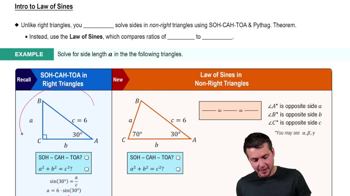
The Law of Sines relates the lengths of the sides of a triangle to the sines of its angles. It states that the ratio of a side length to the sine of its opposite angle is constant for all three sides of the triangle. This law is particularly useful for solving triangles when given two angles and one side or two sides and a non-included angle.
Recommended video:
Triangle Inequality Theorem
The Triangle Inequality Theorem states that the sum of the lengths of any two sides of a triangle must be greater than the length of the third side. This theorem is essential for determining the possibility of forming a triangle with given side lengths and angles, ensuring that the sides can connect to form a closed shape.
Recommended video:
Solving Right Triangles with the Pythagorean Theorem
Ambiguous Case of the Law of Sines
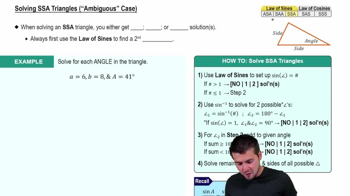
The ambiguous case occurs when using the Law of Sines with two sides and a non-included angle (SSA condition). In this scenario, there can be zero, one, or two possible triangles, depending on the given measurements. Understanding this case is crucial for determining how many triangles can be formed with the provided dimensions.
Recommended video:
Solving SSA Triangles ("Ambiguous" Case)