Four ways to keep kindergarten ESL students focused all day

Heath Pulliam
A teacher sat in a classroom with a child, sharing crayons with eachother and smiling
Reading time: 5 minutes

Heath Pulliam is an independent education writer with a focus on the language learning space. He’s taught English in South Korea and various subjects in the United States to a variety of ages. He’s also a language learning enthusiast and studies Spanish in his free time.

Those who have taught children anywhere between the ages of 4 and 8 know that one of the biggest challenges of getting through to them is keeping your presentation style interesting. As someone who taught ESL in South Korea to kindergarteners, there are a few factors that make keeping students engaged a challenge. In countries where students learn English, students often have a heavy courseload and high expectations. As a first-year teacher, I learned a lot about what worked and what didn’t through trial and error. These are four methods that I consistently used to keep my students interested and engaged all day.

Students are quick to lose focus at such a young age. You’re not speaking their mother tongue and some parts of an ESL curriculum are less than exciting. With young students, you can’t lecture your way through the material all day. Kindergarteners have a small window of focus and it must be capitalized on. The following methods are ones that worked for me and can be modified to cover any topic you’ll run into in an ESL curriculum.

Activities to engage pre-primary ESL students all day
Play
Privacy and cookies

By watching, you agree Pearson can share your viewership data for marketing and analytics for one year, revocable by deleting your cookies.

1. The wheel of names

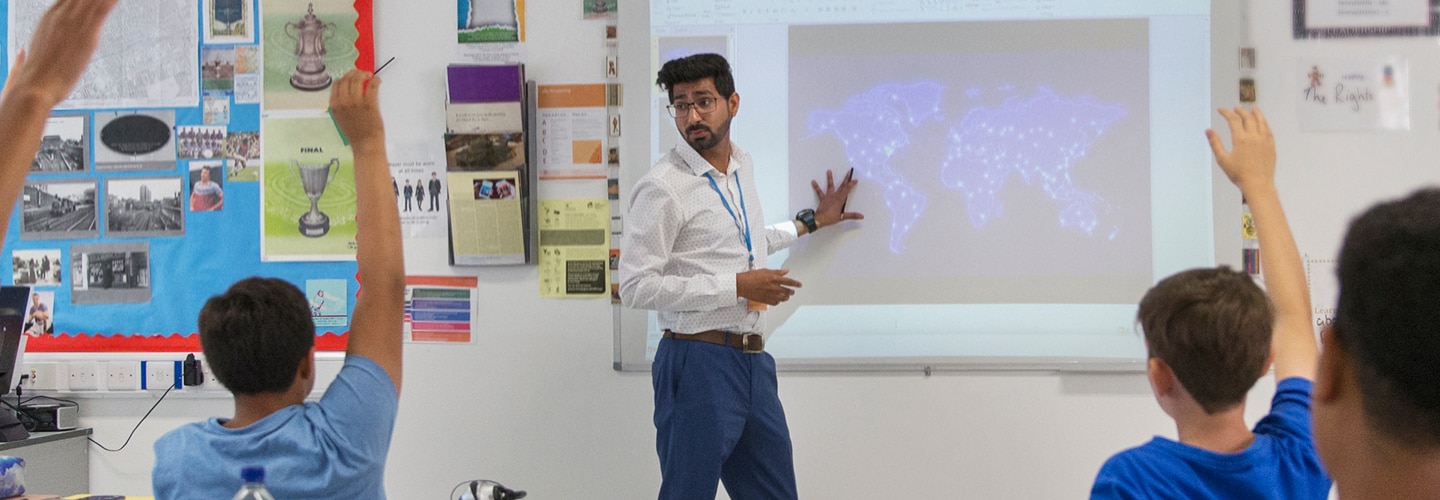
Don't let the simplicity of this tool fool you. The Wheel of Names, which is exactly what it sounds like, is a very simple tool that you can put the names of your students on to randomly (or not) select a student. The Wheel of Names crushes hand-raising and it’s a constant struggle to get everyone raising their hands. (We can’t let the quiet ones just slip through the cracks!)

The beauty of the Wheel of Names is the guaranteed excitement on every spin. They’re kindergarteners. The nature of randomizing who’s going to answer the question, come up to the board, or go first in a game is so exciting to them. Use it however you want. The suspense has kids excited to see who will be chosen and has them cheering on whichever classmate gets chosen.

I used this tool mostly during review sessions to choose students to answer questions. It can also be used for creating small groups, making sure everyone gets a chance to speak during activities and seeing who’s going to get to do the next fun thing in the classroom. You’re teaching kindy, have fun with it.

https://spinthewheel.io/

2. Team-based review game

We never came up with a good name for this game, but we used it a lot. Every Friday, during our chapter review, this was undoubtedly the best compromise between fun and effectiveness for reviewing material. It also fosters speaking, one of the most important parts of learning a language.

Here’s how it works. The class is separated into two teams. (For a little extra fun, use the wheel of names or a cup of popsicle sticks with students’ names on them to select the teams.) The teacher has a set of review questions or vocabulary words. On each turn, one person from each team has a chance to answer the question. You can do hand-raising or a randomization method to pick who answers.

If the student representative from the team gets it right, they earn a point. If they get it wrong, the opposing team gets a chance to answer for a point. Alternating between each team, the first to a certain number of points wins. A simple game, but at this age many students are just getting used to team-based activities.

This game is so effective because it makes use of children’s natural competitive spirit. When one student is up, the rest of their team cheers them on. Learning material is important, but a big part of teaching young students is teaching them social skills, too. This game gets everyone excited and gets the material to stick. It also teaches them the importance of teamwork and how to win and lose gracefully. (Not everyone can win every time).

3. Creating super sentences

At the end of the year, the students in my class ended up being the best writers in their respective age groups. I think this activity, making ‘Super Sentences” a few times a week was a big contributor to that. Inspired by a textbook we had, here’s how this activity works.

We’d create sentences with this formula:

Who or what – The owl

Did what – hunted for mice

Where – in the forest

When – at night

The owl hunted for mice in the forest at night.

Before students got to work on their own, We’d fill out a little table on the board as a class that looked something like this – but changed every time.

Who or what?

(noun)

Did what? (verb)

Where?

(prepositional phrase)

When?

(prepositional phrase)

The dog

The raccoon

Joey

Mr. Heath

Chloe

The thief

Ran

Slept

Attacked _______

Found _________

Learned to ________

sneaked

On top of __________

Under __________

Through the ________

Next to the  ________

Inside of the _______

Behind the ________

At sunset

At 4:00 PM

In the middle of the day

In March

In the evening

After this, students can get to work making their own sentences and drawing what is happening below. After a few times, many students began to make up their own nouns, verbs and prepositions that were not listed on the board. And when everyone gets comfortable writing sentences, you can add a ‘Why?’ section at the end.

This activity is one of my favorites because it helps bring out children’s natural creativity. In an ESL curriculum, there’s a lot of material that’s less than exciting, so any way to give the kids a little freedom can be a game-changer. It’s also great for vocabulary, grammar and writing practice.

To finish off the activity, have each student read their sentence and have the class vote on their favorite for a prize!

4. Vocabulary bingo

Something to know about teaching ESL in non-English-speaking countries is that often, no time is allowed to be spent not learning. This is definitely the case in South Korea. Even after lunch and towards the end of the day, students are rarely allowed to do anything if it isn’t enriching. Because of this, playing games that are fun and learning-effective is a must.

Now, I’m certainly not the first one to play Bingo. This version however, is slightly modified to be as enriching as possible. We played this version often at the end of the day, because focus runs low around that time.

Essentially, this is just vocabulary bingo with a little bit of charades mixed in. For this activity, make a basic bingo board with some of your current vocabulary words or target language. There are plenty of sites that make this easy.

What makes this version different is that on each turn, rather than telling everyone the word, describe it to the class and try to get them to guess what the word is. So, if the word was ‘teamwork’, you might say something like “This is what it’s called when everyone works together to help their team win.” You can even have a student helper that helps facilitate the game by giving the descriptions.

After the word is guessed, reiterate it to the class and proceed with Bingo as usual.

Conclusion

Part of being an effective teacher, especially with the younger ages, is harnessing kids’ natural excitement, energy and innate curiosity to their own benefit. Instead of suppressing it, it’s essential to adapt your teaching style to work for your students.

Teaching ESL to young children has its own set of challenges. They can hardly sit still for an hour of lecture, let alone a whole day. Make use of, or draw inspiration from these methods and see how they can work for you.

Teaching young learners? Read our post 'Effective classroom management routines for very young learners'.

More blogs from Pearson

  • Young students in a classroom raising their hands and smiling
    Putting inquiry-based learning into practice with young learners
    By Jeanne Perrett
    Reading time: 5 minutes

    What are the benefits of inquiry-based learning?

    Inquiry-based learning is all about using questions to generate interest. Starting a class with a question helps young learners engage with the topic straight away. Introductory questions can be big or small, and here are some examples of big questions: 

    • What makes someone a hero? 
    • Why do we go to school? 
    • Why do people live in cities? 

    These open questions get students thinking about lots of different aspects of each topic. However, small questions can work as well: 

    • What is your favourite superhero called? 
    • Do you like your school? 
    • Do you live in a village or a city?

    These closed questions don’t necessarily lead to further discussion. However, they are a way to introduce a topic and give learners an easy way to contribute without the pressure of getting an answer right or wrong. 

    When students are invited to share their opinions, they feel that their contributions are valuable. It also lets the teacher gain insight into what the learners already know. 

    How can we help students explore big questions?

    Inquiry-based learning can support students to answer these big questions in an easy and satisfying way, including:

    • Making notes on their ideas, or drawing a sketch
    • Working in pairs or groups to share ideas
    • Using a bulletin board

    A bulletin board fits in well with the concept of inquiry-based learning. The teacher pins a big question to the center and then encourages learners to add their notes, sketches and ideas to the board. 

    Because there are many possible answers to the big questions, it’s important to emphasize that learners can change their minds as they learn more: after all, that’s the whole point of learning.

    The Now I Know! series follows this structure. Each unit has language aims based around a big question to get learners thinking more deeply.

    How can inquiry-based learning work in practice?

    You can put it into practice in your own classroom by starting off with a topic, and then thinking of a big question to get things started. So, for example, if your topic is outer space, your big question could be: Why do we explore space? 

    That will get your students thinking and sharing their knowledge about space travel, moon landings, astronauts, aliens – you might be surprised at some of their answers. Ask them to write notes, do a sketch or do a mind map, then pin their contributions to your bulletin board. 

    There are lots of options for follow-up activities: 

    • Assign pairs a planet from the solar system to research
    • Share an interesting fact about an unnamed planet and encourage students to research which planet it is
    • Allow students to play to their strengths: one student can draw the planets and another can name their order from the sun (for example)
    • Create a game: get learners to write two false facts and one true fact about their planet, and the rest of the class has to guess which is which

    Once you’ve piqued their interest and the students are excited about the topic, it’s time to channel that enthusiasm into a more focused activity. For example, you could introduce the story of the Golden Record on the Voyager space probe. At the time of the Voyager launch in 1977, a phonograph record was included onboard which contained, in the words of then-president Jimmy Carter, “a present from a small, distant world, a token of our sounds, our science, our images, our music, our thoughts and our feelings.” The record included music from different cultures, greetings in 55 languages and sounds of the natural world. There were also 115 images of life on Earth, many annotated with explanations. 

    Bring it back to inquiry-based learning, and instead of telling students what is on the record, ask them what they think might have been included. Again, they can add their ideas to the bulletin board. 

    Follow-up activities could include: 

    • Making their own recording for an interplanetary space voyage
    • Doing a sound quiz where students record sounds and ask their classmates to guess what each sound is 
    • Making a modern playlist for aliens to listen to 
    • Taking photographs of their daily lives and adding comments, just as the NASA committee did, and doing more research into the Voyager space probe
    • Checking its progress through interstellar space on the NASA website

    This is just one example of a topic, but any topic can be treated in the same way. If you, as a teacher, share your curiosity and enthusiasm with your students, they’ll pick up on that and become enthused in turn.

    How do we nurture enquiring minds?

    The spirit of enquiry is one of the most important things we can instill in our young learners. Inquiring minds are innate - just think of the way toddlers ask “Why?” about everything. The mistake that adults can sometimes make is to reply to the ‘why’ questions with an answer, when actually, sometimes children just want to have a discussion. 

    As educators, it’s important to reply to children’s questions by opening up a discussion, no matter how abstract the question. For example, if a toddler asks something like “Why a leaf?”, you can expand that conversation to talk about colours, trees, nature, things that grow... the possibilities are endless. 

    In fact, this is our main role as educators: to facilitate and continue those conversations, to pique our learners’ curiosity, to share our enthusiasm and wonder rather than simply teach the correct answer.

    Show your students that you don’t have to find immediate answers, that there’s no such thing as a silly answer. It’s okay to wonder and muse. In your lessons, focus not on giving students the answers but on equipping them with the tools to research and find them themselves. In this way, you’ll create lifelong learners with a passion for education. 

  • A group of teenagers working on a activity gathered around a table smiling
    Helping students get out of the holiday slump
    By Charlotte Guest
    Reading time: 4 minutes

    The first days back can be slow. Routines are rusty. Focus is short. That is normal. You do not need to start again. With a few high-impact moves, you can help students switch back on, feel confident and build momentum for the term.

    Start with a short check, then act fast on feedback

    Open with a quick, low-stakes check of key ideas from last term. Keep it short (6–8 items). Include a mix of multiple-choice and one or two short answers. This is not for grades. It is to see what students still remember and where the gaps are. Even when students get items wrong, trying to retrieve helps learning later (Richland, Kornell and Kao, 2009).

    Follow up with clear, task-focused feedback so students know the next step (“Add units to your answer”; “Show the first step”) rather than general comments. Use the results to form two or three quick groups and assign a short, targeted task to each.

  • Two business professionals loooking at notes together
    GSE, KPIs and ROI (Part 2): Turning language data into business value
    By Łukasz Pakuła
    Reading time: 5 minutes

    In Part 1, we looked at how to build a sensible measurement philosophy for language training using KPIs and the Global Scale of English (GSE). We’ve established that language programs shouldn’t be treated as a calendar entry, but as a strategic lever, and that independence, granularity and credibility are the secret sauce.

    Now it’s time to move from how to why: how these datapoints translate into tangible business outcomes, and how to make sure your investment in English doesn’t just look good on slides but actually delivers value when the CFO walks in.

    From measuring to meaning: translating KPIs into ROI

    Let’s be blunt: only a reckless stakeholder invests without expecting a return. Weighing costs and benefits, however, can get tricky. Without some operational clarity, ROI quickly becomes either a fairy tale or a labyrinth, both of which are bad news in risk-averse corporate cultures.

    From a client’s perspective, it’s vital to include all components in your calculation: direct delivery fees, platform access, materials and, ideally, a provider capable of offering the full package. And please don’t forget the indirect cost of time. Two hours of lessons per week equals more than 100 hours per learner per year. Add the asynchronous learning that every serious learner contributes, and we’re suddenly talking about real numbers.

    If you skip that, the ROI will look spectacular on paper until someone performs a reality check and the budget line gets a little uncomfortable. If you’re an L&D manager reading this, add sensible estimates for coordination and reporting. Ideally, your provider helps you keep those to a minimum. At choices®, which provides language services, we see this as part of the service rather than a side quest. Trust me, it saves everyone time and sanity.