



Beyond banning AI: why formative assessment matters more than ever how to put it into practice

Generative AI is changing many areas of education, including English language teaching and assessment. The ELT Edition of Assessment Evolved builds on global research and insights from more than 1,000 educators and expert contributors. And the accompanying ELT Educator Guide turns research into practical strategies for every classroom setting. 

Turn research into practical classroom support

Why partner with us?

Supporting educators to build their learners' real-life English skills and boost their confidence.

Help shape the future of English teaching

Join our Outside In Research community and connect with educators from around the world. Share your insights, take part in research activities and get opportunities to win prizes.

Join Outside In

Stay informed with the latest insights

Get expert insights, teaching resources, product updates, blogs, and webinar invitations delivered straight to your inbox.

Subscribe to our newsletter

Teaching neurodiverse learners with confidence

Get insights on research into neurodiverse classrooms and discover simple ways to support different learning styles, while keeping standards high. See how small changes, from clearer instructions to flexible assessment, can make learning more accessible for everyone.

Download our latest report

Language learning trains the brain for faster, better learning

Discover how language learning transforms the way we acquire new skills. Our latest report explores why traditional education often overlooks the strategies that make learning truly effective, and reveals how mastering additional languages boosts focus, memory and mental flexibility. 

Learn practical strategies to strengthen your learning skills and thrive in today’s fast-changing workplace.

Read the full report

Woman in workshop

Boost your learners' speaking skills with Mondly by Pearson

Enhance learner confidence with over 500 minutes of speaking practice, featuring advanced speech recognition and immersive AI conversations, accessible on-the-go.

Explore Mondly by Pearson

It's time for a game-changing shift in English language learning

Our research reveals that over half of learners feel that their formal education did not prepare them with a good level of English, with just 25% saying they felt confident using all four skills. We want to change that.

Find out how you can better support your English language learners with the skills and confidence they need for their futures in our report.

Enhance teaching strategies

Digital learning experiences

Discover game-changing digital learning platforms that are revolutionizing English language teaching inside and outside of the classroom.

Inspire learners and build their skills with Pearson English Readers

Aligned to the Lexile Global Framework for reading and the Global Scale of English, our Readers are the perfect partner to power up any learner’s journey to fluency.

Find the best Readers for your learners

We have millions of learning enthusiasts in our community

Read the insights from our community.

  • A teacher sat with his students having a group discussion

    Planning lessons around holiday themes for English classes

    By Charlotte Guest
    Reading time: 4 minutes

    As the year draws to a close, holiday themes can provide a fantastic opportunity to bring English lessons to life. From winter celebrations and cultural festivals to New Year traditions and seasonal events, there are plenty of ways to introduce fresh, engaging topics into the English language classroom.

    Holiday-themed lessons offer more than just a seasonal change of scenery. They give students opportunities to learn new vocabulary, practice everyday conversations and develop their confidence using English in real-world contexts.

    But these lessons don't have to revolve around Christmas. With celebrations and traditions taking place around the world throughout the year, teachers can explore a wide range of themes while encouraging students to develop their language skills and cultural awareness.

    Here are five ways to plan engaging, inclusive and educational holiday-themed English lessons.

    1. Explore celebrations from around the world

    While Christmas might be one of the first themes that comes to mind during December, there are many other celebrations and traditions worth exploring. Consider introducing students to Diwali, Hanukkah, Lunar New Year, Kwanzaa, Eid, winter solstice traditions or local seasonal festivals. These topics provide a natural introduction to new vocabulary while encouraging students to learn about different cultures.

    Ask students to read short descriptions of different celebrations and identify key information, such as when they take place, how people celebrate and what traditions are involved.

    You could then organize a class discussion where students compare celebrations, practicing useful phrases such as 'In my country...', 'Similarly...' and 'One difference is...'.

    2. Build vocabulary around seasonal themes

    Holiday topics are an excellent way to introduce vocabulary that students can use in everyday conversations.

    Depending on their English proficiency, you could explore vocabulary relating to:

    • Celebrations and traditions
    • Food, cooking and ingredients
    • Travel and holidays
    • Weather and seasonal activities
    • Gifts, shopping and special occasions

    For beginner learners, picture-matching activities, vocabulary games and simple sentence-building exercises can help reinforce new words.

    For more advanced students, introduce idioms and expressions associated with celebrations, such as 'the most wonderful time of the year', 'ring in the New Year' or 'a fresh start'.

    Encourage students to use their new vocabulary in conversations and written activities rather than simply memorizing definitions.

    3. Encourage real-world communication

    Holiday themes naturally lend themselves to practical speaking activities, helping students practice English in situations they might encounter outside the classroom. For example, try a holiday travel-planning activity. Ask students to work in pairs to plan a trip to a country of their choice, deciding where to go, what to see and how much to spend. They'll need to practice asking questions, making suggestions, expressing preferences and agreeing on plans.

    Other activities could include:

    • Plan a celebration: Students organize their own fictional celebration, deciding on the location, food, activities and guest list before presenting their ideas.
    • Write a holiday invitation: Practice informal writing by asking students to create an invitation to a seasonal event, including the date, location and details.
    • Role-play a shopping trip: Set up a classroom shopping scenario where students practice asking about prices, making purchases and describing products.
    • Holiday interviews: Students interview one another about their favorite celebrations, traditions or seasonal activities, practicing question formation and conversational fluency.

    These activities help students use English with a clear purpose while building confidence and fluency.

    4. Bring reading and writing into the festivities

    Seasonal topics also provide plenty of opportunities to develop reading comprehension and written communication. You could introduce short articles about how different countries celebrate particular holidays, asking students to identify the main ideas, understand unfamiliar vocabulary and answer comprehension questions.

    For writing practice, students could create a short blog post about a celebration, describe their ideal holiday or write about a memorable experience. For more advanced learners, challenge them to compare two celebrations in a structured piece of writing, using linking words and comparative language.

    The key is to choose texts and writing tasks that match students' English proficiency while introducing interesting new language.

    5. Make your lessons inclusive and culturally aware

    Not every student celebrates the same holidays and some may not celebrate any at all. Make sure themed lessons are welcoming and relevant to everyone. Rather than assuming students share particular traditions, introduce a variety of celebrations and allow learners to choose the topics they find most interesting.

    This also creates opportunities to explore cultural differences, practice respectful discussion and develop a broader understanding of the English-speaking world and beyond.
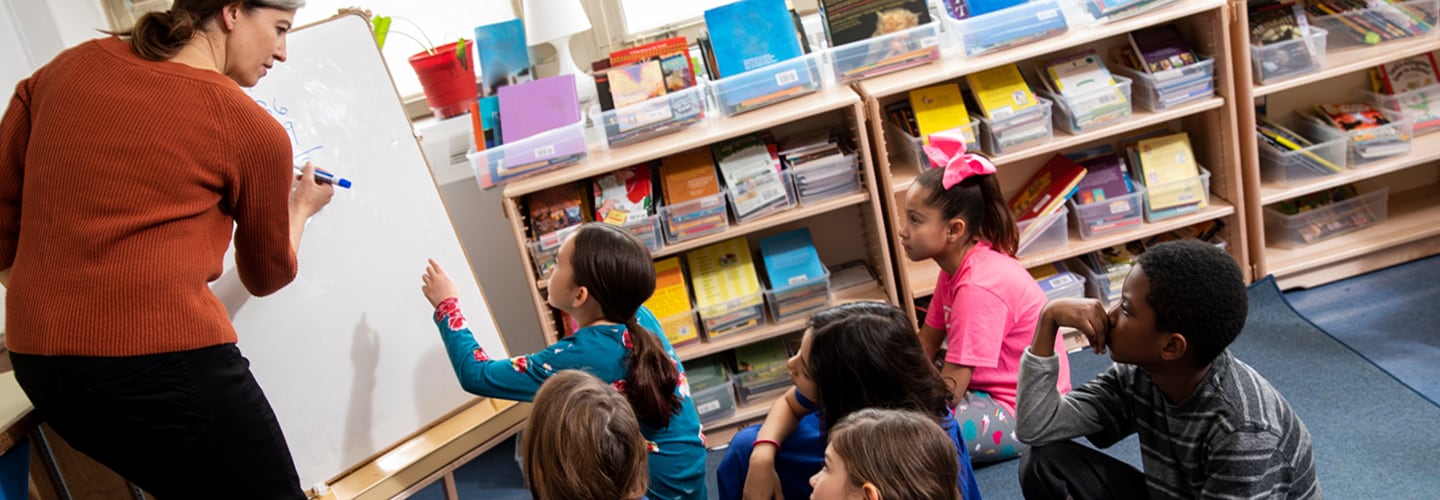

  • A teacher writing on a whiteboard with students sat on the floor participating

    Classroom actitvies: 12 days of Christmas

    By Iram Ahmed
    Reading time: 3 minutes

    With the holiday season approaching, it’s good to add some fun into teaching to keep your students engaged and motivated. We’ve created 12 simple classroom activities and tips that you can carry out with your primary class to encourage them to be good.

    Day 1 - Santa’s watching

    Fact: Father Christmas, St. Nicholas, Sinterklaas – whatever we call him; many countries around the world have a tradition that naughty children will only receive coal, twigs or even onions. But do children always know how to be good?

    Classroom application

    Classroom tip: Catch students being good

    Watch out for good behavior and praise it when you see it. Much more effective than dealing with problems as they arise.

    Day 2 - Christmas countdown

    Fact: Advent calendars count down the days to Christmas, and for children that usually means gifts. But is the festive period all about presents?

    Classroom application

    Classroom tip: Kindness calendar

    Challenge students to carry out one act of kindness every day in December. They can plan this on a blank calendar and tick the kind acts as they complete them.

    Day 3 - Season’s greetings

    Fact: Did you know that greeting students individually at the door improves learning and engagement?

    Classroom application

    Classroom tip: Holiday password

    Have a holiday-themed password for children to give as they enter the classroom. Students choose a new password every lesson.

    Day 4 - Frosty the Snowman

    Fact: The largest snowman in the world was actually a snow-woman. Olympia was over 37 meters tall and had trees for arms.

    Classroom application

    Classroom tip: Concrete poems

    A concrete poem written in a shape that reflects the topic of the poem, for example a poem about a snowman written in the shape of a snowman. Challenge your students to write their own concrete poems about Christmas (or a current holiday for them).

    Day 5 - DIY decorations

    Fact: Chinese New Year is the most important winter festival in China. Like Christmas, one of the main activities is putting up paper decorations.

    Classroom application

    Classroom tip: Collaborative tree

    Each child draws around their hand, cuts it out and either draws a picture or writes a sentence about themselves. The whole class makes a display out of the handprints.

    Day 6 - Star students

    Fact: Stars feature in many Christmas traditions. For example, in Poland, the Christmas Eve feast only starts when the first star appears in the night sky.

    Classroom application

    Classroom tip: 2 stars and a wish

    Give focused feedback on written tasks by identifying two positive aspects of work and one area to work on. Works great for peer assessment too.

    Day 7 - Perfect presents

    Fact: Everyone loves getting presents. In Liberia, instead of Santa bringing toys, you’ll find Old Man Bayka, who walks the streets asking for gifts.

    Classroom application

    Classroom tip: My gift to the world

    Brainstorm things students can do to help make the world a better place, such as volunteering at a local charity or planting a tree. Challenge them to do one thing as a holiday gift to the world.

    Day 8 - Festive feasts

    Fact: Famous fried chicken in Japan, caterpillars in South Africa, hot tamales in Venezuela and oysters in France. Christmas dinners vary greatly as you move around the world.

    Classroom application

    Classroom tip: Recipe for success

    Students can make their own recipe for success by thinking about what they need to be successful in the new year.

    Example (to be designed to look like a child wrote it):

    • 1 cup of doing my best
    • ½ cup of ideas
    • ¼ cup of smiles
    • 2 tablespoons of teamwork
    • 3 teaspoons of listening to the teacher

    Day 9 - Holiday traditions around the world

    Fact: Festive saunas in Finland, roller skating in Venezuela and Christmas cobwebs in Ukraine – no two countries celebrate Christmas in exactly the same way.

    Classroom application

    Classroom tip: Venn diagrams

    Students choose 2 countries and research how they celebrate during wintertime. They record their findings as Venn diagrams. They record the different traditions of the two countries in the sections on the left and right. Anything they have in common goes in the middle.

    Day 10 - The excitement of Christmas

    Fact: Anticipation plays a big part in the excitement of Christmas. Will Santa come? What presents I get? Who will win the annual family game of charades?

    Classroom application

    Classroom tip: Big questions

    Start lessons by posing big questions to engage students’ natural curiosity and motivate them to find answers. Open questions work great, such as How do animals communicate? or What makes someone a hero?

    Day 11 - Holiday cheer

    Fact: Forget the Grinch, the festive season is a time for feeling good and spreading happiness.

    Classroom application

    Classroom tip: Compliment corner

    Allocate a space in the classroom as the compliment corner – a notice board or a big piece of paper. Students can write compliments to each other on sticky notes and put them on the board. Such as ‘I love the pictures you drew of your favorite hobby’ or ‘You’re so good at singing’.

    Day 12 - New Year’s resolutions

    Fact: The start of a new year is a great time to focus on self-improvement, but only 8% of people are successful in sticking to their resolutions.

    Classroom application

    Classroom tip: Self and peer reflection

    At the end of each lesson, ask students to reflect on their learning. Support students by providing sentence stems such as:

    • I learnt…
    • I enjoyed…
    • I’m good at…
    • To improve I will…
    • I didn’t understand…

    Make these activities your own and adapt them to your class. They should help you turn the lead-up to the holidays in the classroom into an exciting one for your students, and almost make them forget they're learning at the same time.

  • A teacher sat at a desk helping a student in the classroom

    A magical mystery tour: How the role of English teacher is changing

    By Leonor Corradi
    Reading time: 5 minutes

    "The only constant is change”, a phrase that the philosopher Heraclitus of Ephesus is widely credited with.

    Though it may look like a paradox, actually it is not. Without becoming too philosophical, one could argue that this statement communicates the real-life truth that perpetual shifting is the single permanent rule in life. How does this apply to teaching and to the teacher’s role in particular? Let’s start our magical mystery tour.

    The first stop: the beginnings of the Communicative Approach

    Before this revolution in the world of ELT, teachers were used to being the center of the classroom – a dominant, all-controlling figure orchestrating every move. Many students were quite happy with this situation, since nothing was unexpected: their creativity and spontaneity were neither welcome nor expected. Errors were not tolerated at all and teachers were supposed to correct them and, even better, prevent them from happening.

    But soon it all changed. Teachers had two primary functions: facilitators of the communication process and independent participants within students’ groups (Breen and Candlin, 1980). No more centrality, which came as a shock to many, not because they were not ready to relinquish power, but because they were not sure how to go about this new role. What is expected from a facilitator, from a person who joins any group as another member?

    Often the answer was this one: “When you are a facilitator, if a person enters your classroom, they won’t know who the teacher is.” This led to misinterpretations of this new role. It was not about making things easier for learners, nor was it about relinquishing power and having learners decide what to do.

    This was natural. Think about a pendulum. When it’s at one end and it is moved, it does not stay in the middle but goes to the other end. Over time the pendulum reached a medium. This meant that teachers left their physical centrality, i.e. they did not stand at the front of the classroom at all times, but understood the centrality of their role in learning.

    The next stops do not follow chronological order because they overlap.

    Stop two: Task-based learning

    Our next stop: Task-based learning (Willis, 1996 and Nunan, 1989). As it could be argued that it is a framework within communicative approaches, it did not create the same uneasiness in some teachers as the Communicative Approach. The teacher’s role is more structured, especially in Willis’s framework. Teachers select and sequence tasks, monitor students as they work without correcting mistakes, yet provide scaffolding as needed and help students notice language features and become aware of how language works.

    Unlike early Communicative Language Teaching, form gets explicit attention, yet after students have been using language, i.e., after the task.

    Stop three: Project-based learning.

    Teachers move further away towards the background, acting as a coach or guide. They are expected to negotiate projects with their learners, provide scaffolding and language support as needed and assess both process and product, also encouraging self and peer assessment.

    Stop four: The Lexical Approach

    The stop: The Lexical Approach (Lewis, 1997). Teachers provide input and work toward learners noticing and discovering language features, while learners play an active, central role.

    Stop five: Teachers today

    The question goes around in society, “Will teachers be replaced by AI? Will they be necessary at all?” The answer to those questions is “No, teachers won't be replaced and will always be necessary." Why? What is there in our role that makes us unique? On the one hand, we know that we should mediate between learners and teaching materials.

    This mediation cannot be black and white, since all groups are different and, even within each group, learners have different styles and needs and are affected by different situations. It is the teacher who knows this and knows when to adapt on the spur of the moment, just by looking at their learners’ faces. Often a learner’s question or comment helps us know where they are in their learning process and the scaffolding we give takes that as the starting point.

    AI is a fantastic resource, but it is still a resource. It can help teachers generate materials and it can help learners by offering tailored information, answers to queries they may have when the teacher is not here to help, among other ideas. But the teacher has the final say before giving students AI-generated materials. The teacher’s critical reflection and mediation ensure the materials support learning.

    As explained before, the teacher is not at the front of the classroom, yet their role is central to students’ learning.

    We have come to the end of the magical mystery tour, and a question seems natural: Will AI become more intelligent and be context-sensitive in the way teachers are? We do not know. However, there have been different attempts to replace teachers since Skinner’s Teaching Machine and still, it is the teacher’s humanity that can make all the difference.

Level-up your skills with our free webinars

Register to join live or watch the recordings now.

Sorry, there are no upcoming webinars to display.

* Global online survey on Learner's Voice among just over 2,000 respondents including teachers and learners of English, decision makers in educational institutions and companies, Jan-Mar 2022.