
Ch. 4 - Applications of the Derivative
Briggs - Calculus: Early Transcendentals 3rd Edition
Briggs3rd EditionCalculus: Early TranscendentalsISBN: 9780136847243Not the one you use?Change textbook
Chapter 4, Problem 4.5.71b

Cylinder in a cone A right circular cylinder is placed inside a cone of radius R and height H so that the base of the cylinder lies on the base of the cone.


b. Find the dimensions of the cylinder with maximum lateral surface area (area of the curved surface).

Verified step by step guidance
1
Understand the problem: We need to find the dimensions of a cylinder with maximum lateral surface area that fits inside a cone with given radius R and height H. The lateral surface area of a cylinder is given by the formula: \( A = 2\pi rh \), where \( r \) is the radius and \( h \) is the height of the cylinder.
Set up the relationship between the cone and the cylinder: The cylinder is inscribed in the cone, so its dimensions are constrained by the cone's dimensions. The cone's equation in terms of its height and radius is \( \frac{r}{R} = \frac{H-h}{H} \), where \( r \) and \( h \) are the radius and height of the cylinder, respectively.
Express the height of the cylinder in terms of its radius: From the relationship \( \frac{r}{R} = \frac{H-h}{H} \), solve for \( h \) to get \( h = H - \frac{Hr}{R} \).
Substitute \( h \) in the lateral surface area formula: Replace \( h \) in \( A = 2\pi rh \) with the expression from the previous step to get \( A = 2\pi r(H - \frac{Hr}{R}) \). Simplify this to \( A = 2\pi rH - \frac{2\pi Hr^2}{R} \).
Find the maximum lateral surface area: To maximize \( A \), take the derivative of \( A \) with respect to \( r \), set it to zero, and solve for \( r \). This will give the radius of the cylinder that maximizes the lateral surface area. Use this \( r \) to find the corresponding \( h \) using the expression from step 3.

Verified video answer for a similar problem:

This video solution was recommended by our tutors as helpful for the problem above.
Video duration:
8m
Was this helpful?

Key Concepts

Here are the essential concepts you must grasp in order to answer the question correctly.

Lateral Surface Area of a Cylinder

The lateral surface area of a cylinder is the area of the curved surface that connects the top and bottom bases. It can be calculated using the formula A = 2πrh, where r is the radius of the base and h is the height of the cylinder. Understanding this concept is crucial for determining how to maximize the surface area in the context of the problem.
Recommended video:
09:07
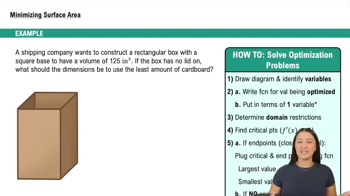
Example 1: Minimizing Surface Area

Optimization in Calculus

Optimization involves finding the maximum or minimum values of a function within a given domain. In this problem, we need to apply techniques such as taking derivatives and setting them to zero to find the dimensions of the cylinder that maximize its lateral surface area. This concept is fundamental in calculus for solving real-world problems involving constraints.
Recommended video:
10:13
Intro to Applied Optimization: Maximizing Area

Geometric Relationships in 3D Shapes

Understanding the geometric relationships between the cylinder and the cone is essential for this problem. The dimensions of the cylinder are constrained by the dimensions of the cone, specifically its radius R and height H. This relationship can be expressed using similar triangles, which helps in deriving the equations needed to optimize the lateral surface area.
Recommended video:
06:29
Derivatives Applied To Velocity
Related Practice
Textbook Question

107–110. {Use of Tech} Motion with gravity Consider the following descriptions of the vertical motion of an object subject only to the acceleration due to gravity. Begin with the acceleration equation a(t) = v' (t) = -g , where g = 9.8 m/s² .

b. Find the position of the object for all relevant times. 

A payload is released at an elevation of 400 m from a hot-air balloon that is rising at a rate of 10 m/s.

43
views
Textbook Question

{Use of Tech} A damped oscillator The displacement of an object as it bounces vertically up and down on a spring is given by y(t) = 2.5e⁻ᵗ cos 2t, where the initial displacement is y(0) = 2.5 and y = 0 corresponds to the rest position (see figure). <IMAGE>


c. Find the time at which the object passes the rest position for the second time.

248
views
Textbook Question

Suppose S = x + 2y is an objective function subject to the constraint xy = 50, for x > 0 and y > 0.

b. Find the absolute minimum value of S subject to the given constraint.

283
views
Textbook Question

{Use of Tech} Basketball shot A basketball is shot with an initial velocity of v ft/s at an angle of 45° to the floor. The center of the basketball is 8 ft above the floor at a horizontal distance of 18 feet from the center of the basketball hoop when it is released. The height h (in feet) of the center of the basketball after it has traveled a horizontal distance of x feet is modeled by the function h(x) = 32x² / v² + x + 8 (see figure). <IMAGE>


b. During the flight of the basketball, show that the distance s from the center of the basketball to the front of the hoop is s = √ (x - 17.25)² + ( -(4x² / 81) + x - 2)² (Hint: The diameter of the basketball hoop is 18 inches.) 

237
views
Textbook Question

{Use of Tech} A damped oscillator The displacement of an object as it bounces vertically up and down on a spring is given by y(t) = 2.5e⁻ᵗ cos 2t, where the initial displacement is y(0) = 2.5 and y = 0 corresponds to the rest position (see figure). <IMAGE>

b. Find the time and the displacement when the object reaches its lowest point.

235
views
Textbook Question

{Use of Tech} Fixed points of quadratics and quartics Let f(x) = ax(1 -x), where a is a real number and 0 ≤ a ≤ 1. Recall that the fixed point of a function is a value of x such that f(x) = x (Exercises 48–51). 


b. Consider the polynomial g(x) = f(f(x)). Write g in terms of a and powers of x. What is its degree?

341
views