In Exercises 71–78, solve each equation. Then determine whether the equation is an identity, a conditional equation, or an inconsistent equation. 5x + 7 = 2x + 7
Ch. 1 - Equations and Inequalities

Chapter 2, Problem 75a
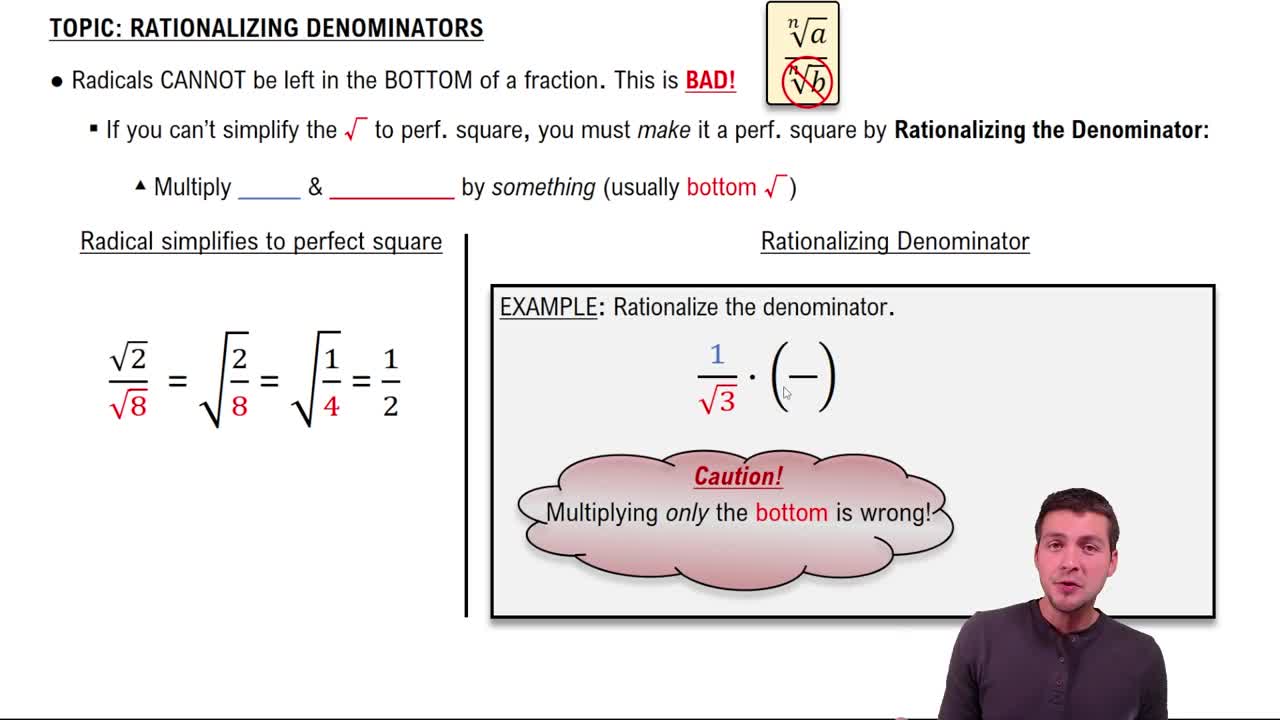
Exercises 73–75 will help you prepare for the material covered in the next section. Rationalize the denominator: (7 + 4√2)/(2 - 5√2).
Verified step by step guidance1
Identify the problem: The goal is to rationalize the denominator of the given expression \((7 + 4\sqrt{2}) / (2 - 5\sqrt{2})\). This means eliminating the square root from the denominator by multiplying both numerator and denominator by the conjugate of the denominator.
Determine the conjugate of the denominator: The conjugate of \(2 - 5\sqrt{2}\) is \(2 + 5\sqrt{2}\). Multiplying by the conjugate will use the difference of squares formula \((a - b)(a + b) = a^2 - b^2\) to eliminate the square root.
Multiply both numerator and denominator by the conjugate: Multiply \((7 + 4\sqrt{2})\) by \((2 + 5\sqrt{2})\) in the numerator, and \((2 - 5\sqrt{2})\) by \((2 + 5\sqrt{2})\) in the denominator. This ensures the value of the expression remains unchanged.
Simplify the denominator: Use the difference of squares formula \((a - b)(a + b) = a^2 - b^2\) to simplify \((2 - 5\sqrt{2})(2 + 5\sqrt{2})\). This will result in \(2^2 - (5\sqrt{2})^2\).
Simplify the numerator: Expand \((7 + 4\sqrt{2})(2 + 5\sqrt{2})\) using the distributive property (FOIL method). Combine like terms, ensuring to simplify any terms involving \(\sqrt{2}\). After simplifying both numerator and denominator, the expression will be rationalized.

Verified video answer for a similar problem:
This video solution was recommended by our tutors as helpful for the problem above.
Video duration:
3mWas this helpful?
Key Concepts
Here are the essential concepts you must grasp in order to answer the question correctly.
Rationalizing the Denominator
Rationalizing the denominator involves eliminating any irrational numbers from the denominator of a fraction. This is typically achieved by multiplying both the numerator and the denominator by a suitable expression that will result in a rational number in the denominator. For example, if the denominator contains a square root, multiplying by the conjugate can help achieve this.
Recommended video:
Guided course
Rationalizing Denominators
Conjugates
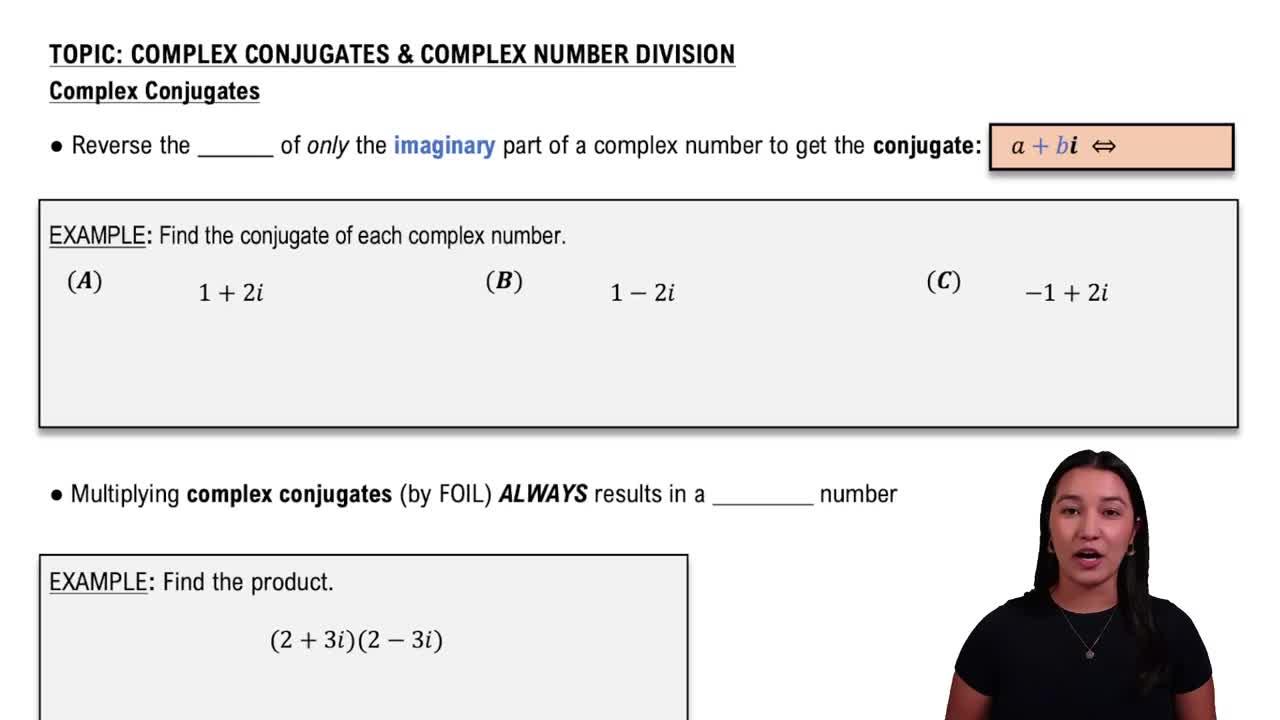
The conjugate of a binomial expression is formed by changing the sign of the second term. For instance, the conjugate of (a + b) is (a - b). When multiplying a binomial by its conjugate, the result is a difference of squares, which eliminates the square root in the denominator, making it easier to rationalize.
Recommended video:
Complex Conjugates
Simplifying Radicals
Simplifying radicals involves reducing a square root or other root to its simplest form. This can include factoring out perfect squares from under the radical sign or rewriting the expression in a way that minimizes the radical's complexity. Understanding how to simplify radicals is essential for effectively rationalizing denominators and simplifying expressions.
Recommended video:
Guided course
Adding & Subtracting Unlike Radicals by Simplifying
Related Practice
Textbook Question
675
views
Textbook Question
In Exercises 75–82, compute the discriminant. Then determine the number and type of solutions for the given equation.
909
views
Textbook Question
The rule for rewriting an absolute value equation without absolute value bars can be extended to equations with two sets of absolute value bars: If u and v represent algebraic expressions, then |u| = |v| is equivalent to u = v or u = - v. Use this to solve the equations in Exercises 77–84. |3x - 1| = |x + 5|
719
views
Textbook Question
In Exercises 61–76, solve each absolute value equation or indicate that the equation has no solution. |2x - 1| + 3 = 3
719
views
Textbook Question
Solve each equation by the method of your choice.
809
views
Textbook Question
In Exercises 75–82, compute the discriminant. Then determine the number and type of solutions for the given equation.
1462
views