
Exercises 41–60 contain rational equations with variables in denominators. For each equation, a. write the value or values of the variable that make a denominator zero. These are the restrictions on the variable. b. Keeping the restrictions in mind, solve the equation. 1/(x - 1) + 5 = 11/(x - 1)
Ch. 1 - Equations and Inequalities

Chapter 2, Problem 49
In all exercises, other than exercises with no solution, use interval notation to express solution sets and graph each solution set on a number line. In Exercises 27–50, solve each linear inequality. 5(x - 2) - 3(x + 4) ≥ 2x - 20
Verified step by step guidance1
Distribute the constants inside the parentheses on the left side: multiply 5 by (x - 2) and -3 by (x + 4), resulting in \$5x - 10\( and \)-3x - 12$ respectively.
Combine like terms on the left side by adding \$5x\( and \)-3x\(, and adding \)-10\( and \)-12$, to simplify the left side expression.
Rewrite the inequality with the simplified left side and the right side as is: \(\text{(simplified left side)} \geq 2x - 20\).
Get all variable terms on one side and constants on the other by subtracting \$2x$ from both sides and adding or subtracting constants accordingly.
Solve for \(x\) by isolating it on one side, then express the solution set in interval notation and prepare to graph it on a number line.

Verified video answer for a similar problem:
This video solution was recommended by our tutors as helpful for the problem above.
Video duration:
2mWas this helpful?
Key Concepts
Here are the essential concepts you must grasp in order to answer the question correctly.
Solving Linear Inequalities
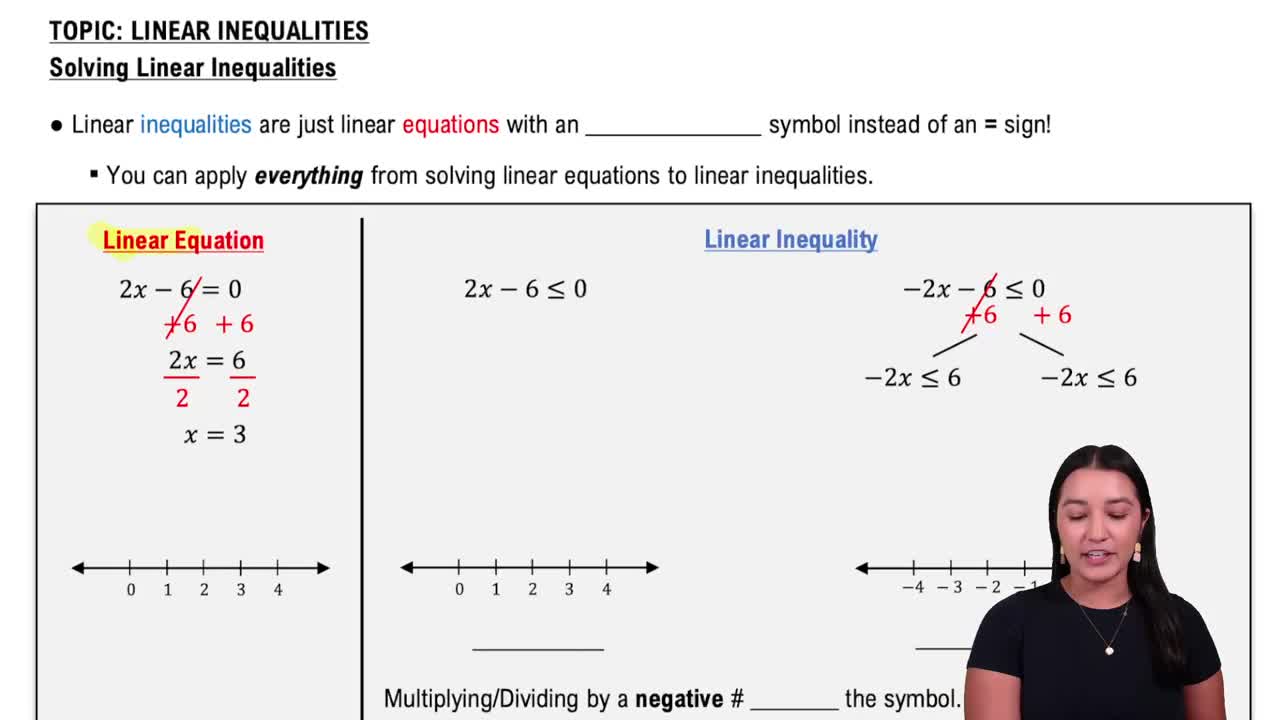
Linear inequalities involve expressions with variables raised to the first power and inequality symbols (>, <, ≥, ≤). Solving them requires isolating the variable on one side by performing algebraic operations, similar to solving linear equations, but with attention to inequality rules.
Recommended video:
Linear Inequalities
Properties of Inequalities
When solving inequalities, adding or subtracting the same number on both sides preserves the inequality direction. However, multiplying or dividing both sides by a negative number reverses the inequality sign. Understanding these properties is essential to correctly solve and interpret inequalities.
Recommended video:
Linear Inequalities
Interval Notation and Graphing Solutions
Interval notation expresses solution sets as intervals on the number line, using parentheses for strict inequalities and brackets for inclusive inequalities. Graphing these solutions visually represents the range of values satisfying the inequality, aiding in comprehension and communication of the solution.
Recommended video:
Interval Notation
Related Practice
Textbook Question
1378
views
Textbook Question
Write each English sentence as an equation in two variables. Then graph the equation. The y-value is three decreased by the square of the x-value.
950
views
Textbook Question
In Exercises 35–54, solve each formula for the specified variable. Do you recognize the formula? If so, what does it describe? S = C/(1 - r) for r
700
views
Textbook Question
Exercises 41–60 contain rational equations with variables in denominators. For each equation, a. write the value or values of the variable that make a denominator zero. These are the restrictions on the variable. b. Keeping the restrictions in mind, solve the equation. 3/(x + 4) - 7 = - 4/(x + 4)
774
views
Textbook Question
Solve each equation in Exercises 47–64 by completing the square.
1195
views
Textbook Question
Perform the indicated operations and write the result in standard form.
805
views
