Use the various properties of exponential and logarithmic functions to evaluate the expressions in parts (a)–(c). Given ƒ(x) = 3x, find ƒ(log3 2)
Ch. 4 - Inverse, Exponential, and Logarithmic Functions

Chapter 5, Problem 97
Given that log10 2 ≈ 0.3010 and log10 3 ≈ 0.4771, find each logarithm without using a calculator. log10 9/4
Verified step by step guidance1
Recognize that the logarithm of a quotient can be expressed as the difference of logarithms: \(\log_{10} \left( \frac{9}{4} \right) = \log_{10} 9 - \log_{10} 4\).
Express 9 and 4 in terms of their prime factors: \(9 = 3^2\) and \(4 = 2^2\).
Use the logarithm power rule to rewrite the logs: \(\log_{10} 9 = \log_{10} (3^2) = 2 \log_{10} 3\) and \(\log_{10} 4 = \log_{10} (2^2) = 2 \log_{10} 2\).
Substitute the given approximate values into the expression: \(2 \log_{10} 3 - 2 \log_{10} 2\) becomes \(2 \times 0.4771 - 2 \times 0.3010\).
Simplify the expression by performing the multiplications and then subtracting to find the value of \(\log_{10} \left( \frac{9}{4} \right)\).

Verified video answer for a similar problem:
This video solution was recommended by our tutors as helpful for the problem above.
Video duration:
3mWas this helpful?
Key Concepts
Here are the essential concepts you must grasp in order to answer the question correctly.
Properties of Logarithms
Logarithms have specific properties that simplify calculations, such as the product rule (log_b(xy) = log_b x + log_b y), quotient rule (log_b(x/y) = log_b x - log_b y), and power rule (log_b(x^n) = n log_b x). These allow breaking down complex expressions into simpler parts.
Recommended video:
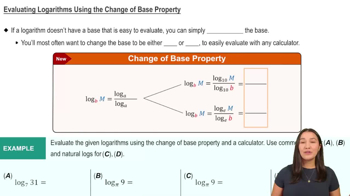
Change of Base Property
Change of Base and Given Logarithm Values
Using known logarithm values, like log_10 2 ≈ 0.3010 and log_10 3 ≈ 0.4771, helps compute other logarithms by expressing numbers in terms of these bases. This avoids calculator use by rewriting numbers as products or quotients of known values.
Recommended video:
Change of Base Property
Expressing Numbers as Products or Quotients of Prime Factors
To use given logarithm values effectively, numbers should be factored into primes or known bases. For example, 9/4 can be written as (3^2)/(2^2), enabling the use of logarithm properties and known values to find the logarithm of the entire expression.
Recommended video:
Guided course
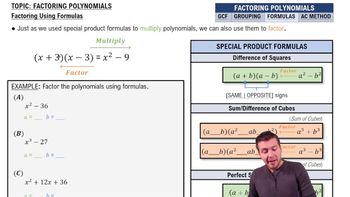
Factor Using Special Product Formulas
Related Practice
Textbook Question
775
views
Textbook Question
Solve each equation for the indicated variable. Use logarithms with the appropriate bases. A = P (1 + r/n)tn, for t
1009
views
Textbook Question
Use the various properties of exponential and logarithmic functions to evaluate the expressions in parts (a)–(c). Given ƒ(x) = log2 x, find ƒ(2log_2 2)
730
views
Textbook Question
Use the various properties of exponential and logarithmic functions to evaluate the expressions in parts (a)–(c). Given ƒ(x) = log2 x, find ƒ(27)
749
views
Textbook Question
Use the various properties of exponential and logarithmic functions to evaluate the expressions in parts (a)–(c). Given ƒ(x) = 3x, find ƒ(log3 (ln 3))
761
views
Textbook Question
Use the various properties of exponential and logarithmic functions to evaluate the expressions in parts (a)–(c). Given ƒ(x) = 3x, find ƒ(log3 (2 ln 3))
811
views