


Ch. 5 The Integumentary System
Amerman- Human Anatomy & Physiology 3e
Amerman3rd EditionHuman Anatomy & PhysiologyISBN: 9780138247201, 9780138247928, 9780138201814Not the one you use?Change textbook
Chapter 5, Problem 7d

Mark the following statements as true or false. If a statement is false, correct it to make a true statement.
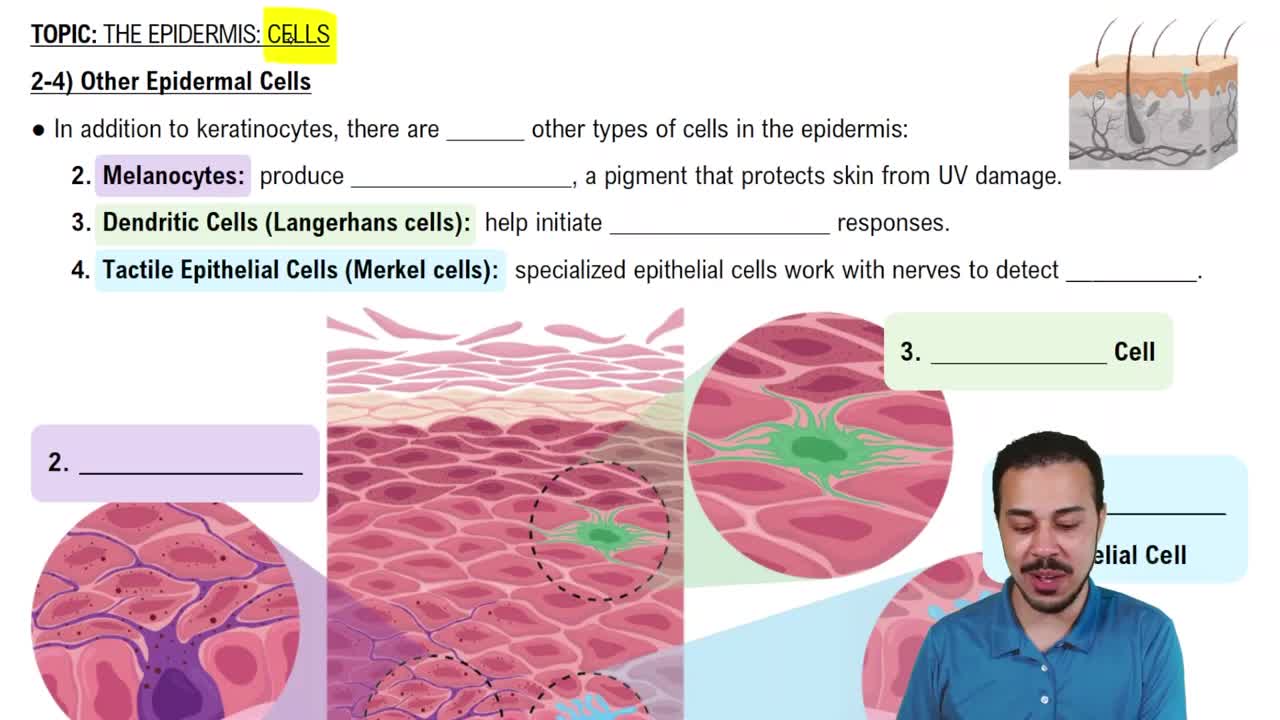
Tactile cells produce the pigment melanin.

Verified step by step guidance
1
Understand the role of tactile cells: Tactile cells, also known as Merkel cells, are specialized sensory cells located in the epidermis. Their primary function is to detect touch and relay sensory information to the nervous system. They are not involved in pigment production.
Understand the role of melanin: Melanin is a pigment responsible for skin, hair, and eye color. It is produced by melanocytes, which are specialized cells located in the basal layer of the epidermis.
Evaluate the statement: The statement claims that tactile cells produce melanin. Since tactile cells are sensory cells and not involved in pigment production, this statement is false.
Correct the false statement: To make the statement true, it should be corrected to say, 'Melanocytes produce the pigment melanin.'
Conclude: The corrected statement accurately reflects the roles of tactile cells and melanocytes in the skin.

Verified video answer for a similar problem:

This video solution was recommended by our tutors as helpful for the problem above.
Was this helpful?

Key Concepts

Here are the essential concepts you must grasp in order to answer the question correctly.

Tactile Cells

Tactile cells, also known as Merkel cells, are specialized skin cells that are involved in the sensation of touch. They are located in the epidermis and are associated with nerve endings, allowing them to play a crucial role in mechanoreception. Unlike melanocytes, which produce melanin, tactile cells are primarily responsible for detecting pressure and texture.
Recommended video:
07:02
Other Epidermal Cells

Melanin Production

Melanin is a pigment produced by melanocytes, which are found in the skin, hair, and eyes. This pigment is responsible for the coloration of these tissues and provides some protection against UV radiation. The production of melanin is influenced by genetic factors and environmental exposure, particularly sunlight.
Recommended video:
07:25
Total Products for Each Stage of Aerobic Cellular Respiration

True or False Statements

True or false statements are assertions that can be evaluated as either correct or incorrect. In the context of the question, understanding the factual accuracy of statements about biological functions is essential. Correcting false statements involves identifying the inaccuracies and providing the correct information, which is a key skill in scientific literacy.
Recommended video:
1:46
Structural Class: Synovial Joints Example 3
Related Practice
Textbook Question

Epidermal ridges are created by:

a. The epidermal papillae

b. Mounds of papillary dermis arranged into dermal ridges

c. Gaps between collagen bundles in the reticular layer

d. Tight binding of the reticular layer to deeper structures

1225
views
Textbook Question

What are the functions of the dermal papillae?

1773
views
Textbook Question

Mark the following statements as true or false. If a statement is false, correct it to make a true statement.

Melanocytes account for the bulk of the epidermis.

956
views
Textbook Question

Mark the following statements as true or false. If a statement is false, correct it to make a true statement.

Dendritic cells are phagocytes of the immune system that protect the skin and deeper tissues from invasion by pathogens.

1107
views
2
rank
Textbook Question

Keratinocytes in the superficial strata of the epidermis die because:

a. They are too far away from the blood supply in the dermis.

b. They are surrounded by a lipid-based substance that makes them more permeable to water.

c. They do not die.

d. No keratinocytes in the epidermis are alive.

981
views
Textbook Question

Which of the following statements is false?

a. Thin skin lacks the stratum lucidum, whereas thick skin has all five epidermal layers.

b. Thick skin is located on the palms, the palmar surfaces of the fingers, the soles of the feet, and the plantar surface of the toes, whereas thin skin is located everywhere else.

c. Thick skin has numerous hairs, whereas thin skin lacks hairs.

d. Thin skin has a thin stratum corneum, and the other layers are thinner than what we find in thick skin.

1427
views