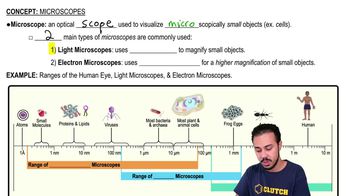
The ultrastructure of a chloroplast is best studied using a a. Light microscope b. Scanning electron microscope c. Transmission electron microscope d. Light microscope and fluorescent dyes
Verified step by step guidance
1
Understand the question: The problem asks which type of microscope is best suited to study the ultrastructure of a chloroplast. The term 'ultrastructure' refers to the fine details of a cell's internal structure, typically at the molecular or organelle level.
Review the options: Each type of microscope has specific capabilities. A light microscope is limited in resolution and cannot reveal ultrastructural details. A scanning electron microscope (SEM) provides detailed surface images but not internal structures. A transmission electron microscope (TEM) is designed to study internal structures at high resolution. Light microscopes with fluorescent dyes enhance visualization but still lack the resolution needed for ultrastructure.
Recall the principle of resolution: The resolution of a microscope determines its ability to distinguish between two closely spaced points. TEMs have the highest resolution among the options listed, allowing them to visualize ultrastructural details such as thylakoid membranes and grana within chloroplasts.
Match the tool to the task: Since the question specifies studying the ultrastructure, the microscope must provide high-resolution images of internal structures. This aligns with the capabilities of a transmission electron microscope (TEM).
Conclude the reasoning: Based on the above analysis, the transmission electron microscope (TEM) is the most appropriate tool for studying the ultrastructure of a chloroplast.
Verified video answer for a similar problem:
This video solution was recommended by our tutors as helpful for the problem above
Video duration:
1m
Play a video:
Was this helpful?
Key Concepts
Here are the essential concepts you must grasp in order to answer the question correctly.
Chloroplast Structure
Chloroplasts are organelles found in plant cells and some algae, responsible for photosynthesis. They contain thylakoids, which are membrane-bound structures where light-dependent reactions occur, and stroma, the fluid surrounding thylakoids where the Calvin cycle takes place. Understanding their ultrastructure is crucial for studying how plants convert light energy into chemical energy.
Different microscopy techniques provide varying levels of detail and types of information about cellular structures. Light microscopes allow for the observation of living cells but have limited resolution. In contrast, electron microscopes, such as scanning and transmission types, offer much higher resolution, enabling the visualization of ultrastructural details at the nanometer scale, which is essential for studying chloroplasts.
Resolution refers to the ability of a microscope to distinguish between two closely spaced objects, while magnification is the process of enlarging an image. For studying chloroplast ultrastructure, high resolution is necessary to observe fine details such as thylakoid membranes and granum stacks. Transmission electron microscopes provide the highest resolution, making them ideal for examining the intricate structures within chloroplasts.