Pearson+ LogoPearson+ Logo
Ch. 3 The Molecules of Cells
Taylor - Campbell Biology: Concepts & Connections 10th Edition
Taylor, Simon, Dickey, Hogan10th EditionCampbell Biology: Concepts & ConnectionsISBN: 9780136538783Not the one you use?Change textbook
Chapter 3, Problem 13

Explain the role of complementary base pairing in the functions of nucleic acids.

Verified step by step guidance
1
Understand the structure of nucleic acids: Nucleic acids, such as DNA and RNA, are composed of nucleotides that include a phosphate group, a sugar (deoxyribose in DNA and ribose in RNA), and a nitrogenous base. The nitrogenous bases are adenine (A), thymine (T), cytosine (C), guanine (G) in DNA, and adenine (A), uracil (U), cytosine (C), guanine (G) in RNA.
Learn about base pairing rules: In DNA, adenine (A) pairs with thymine (T) and cytosine (C) pairs with guanine (G) through hydrogen bonds. In RNA, adenine (A) pairs with uracil (U) instead of thymine.
Explore the significance in DNA replication: During DNA replication, the double helix of DNA unwinds, and each strand serves as a template for the formation of a new complementary strand. The base pairing rules ensure that each new DNA molecule is an exact copy of the original, maintaining genetic consistency across cellular generations.
Examine the role in transcription: In transcription, a segment of DNA is used as a template to synthesize a complementary RNA strand. The RNA polymerase enzyme reads the DNA template strand and synthesizes the RNA strand by adding nucleotides that are complementary to the DNA template, again following base pairing rules.
Consider the importance in translation: During translation, the mRNA sequence is read in sets of three nucleotides called codons, each of which specifies a particular amino acid. The tRNA molecules, which bring amino acids to the ribosome, have anticodons that are complementary to the mRNA codons, ensuring that the correct amino acids are added to the growing polypeptide chain.

Verified video answer for a similar problem:

This video solution was recommended by our tutors as helpful for the problem above.
Video duration:
2m
Was this helpful?

Key Concepts

Here are the essential concepts you must grasp in order to answer the question correctly.

Complementary Base Pairing

Complementary base pairing refers to the specific hydrogen bonding between nucleotide bases in DNA and RNA. In DNA, adenine pairs with thymine, and cytosine pairs with guanine, while in RNA, adenine pairs with uracil instead of thymine. This precise pairing is crucial for the accurate replication of genetic information and the synthesis of proteins, ensuring that the genetic code is faithfully transmitted.
Recommended video:

Nucleic Acids

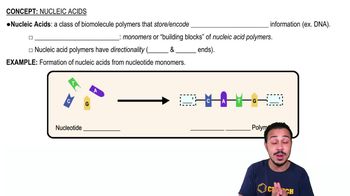
Nucleic acids, primarily DNA and RNA, are biopolymers essential for all known forms of life. DNA stores genetic information, while RNA plays a key role in translating that information into proteins. The structure of nucleic acids, including their sequences and the interactions between bases, is fundamental to their function in heredity and cellular processes.
Recommended video:
Guided course
03:22
Nucleic Acids

Genetic Information Transfer

The transfer of genetic information involves the processes of replication, transcription, and translation. During replication, DNA is copied to ensure genetic continuity. Transcription converts DNA into messenger RNA (mRNA), which then guides the synthesis of proteins during translation. Complementary base pairing is vital in each of these processes, as it ensures the correct sequence of nucleotides is maintained and interpreted.
Recommended video:
Guided course
04:42
Horizontal Gene Transfer