Most proteins are soluble in the aqueous environment of a cell. Knowing that, where in the overall three-dimensional shape of a protein would you expect to find amino acids with hydrophobic R groups?
Verified step by step guidance
1
Understand the structure of proteins: Proteins are made up of amino acids linked together by peptide bonds forming a polypeptide chain. Each amino acid has a unique side chain, known as an R group, which can be hydrophobic or hydrophilic.
Recognize the importance of protein folding: Protein folding is the process by which a protein structure assumes its functional shape or conformation. It is crucial for the protein's function.
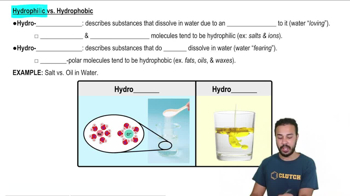
Identify the role of hydrophobic and hydrophilic R groups: Hydrophobic R groups are typically nonpolar and tend to avoid water, whereas hydrophilic R groups are polar and interact well with water.
Predict the location of hydrophobic R groups in a folded protein: Since most proteins function in an aqueous environment inside the cell, the hydrophobic R groups are likely to be tucked away inside the protein structure. This arrangement helps to stabilize the protein structure by keeping these nonpolar groups away from the aqueous environment.
Visualize the protein structure: In the three-dimensional structure of a protein, hydrophobic R groups are generally found in the interior of the protein, away from the surrounding water molecules. This helps in maintaining the integrity and functionality of the protein.
Verified video answer for a similar problem:
This video solution was recommended by our tutors as helpful for the problem above
Video duration:
2m
Play a video:
Was this helpful?
Key Concepts
Here are the essential concepts you must grasp in order to answer the question correctly.
Protein Structure
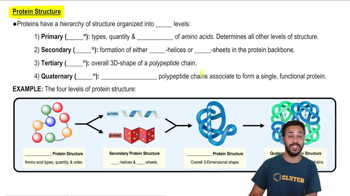
Proteins have four levels of structure: primary, secondary, tertiary, and quaternary. The tertiary structure is particularly important as it determines the overall three-dimensional shape of the protein, which is crucial for its function. This structure is influenced by various interactions among amino acids, including hydrophobic and hydrophilic interactions.
Amino acids possess R groups that can be classified as hydrophobic (water-repelling) or hydrophilic (water-attracting). In an aqueous environment, hydrophobic R groups tend to cluster together in the interior of the protein to avoid water, while hydrophilic R groups are more likely to be found on the surface, interacting with the surrounding water molecules.
Protein folding is the process by which a protein achieves its functional three-dimensional shape. This process is driven by the chemical properties of the amino acids, including their hydrophobicity and hydrophilicity. Proper folding is essential for protein function, and misfolded proteins can lead to diseases.