Pearson+ LogoPearson+ Logo
Ch. 10 - Genetically Modified Organisms
Belk, Maier - Biology: Science for Life 6th Edition
Belk, Maier6th EditionBiology: Science for LifeISBN: 9780135214084Not the one you use?Change textbook
Chapter 10, Problem 8

A particular triplet of bases in the coding sequence of DNA is TGA. The anticodon on the tRNA that binds to the mRNA codon is ________.
a. TGA
b. UGA
c. UCU
d. ACU

Verified step by step guidance
1
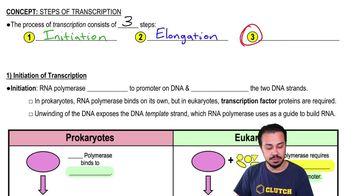
Understand the central dogma of molecular biology: DNA is transcribed into mRNA, and mRNA is translated into protein. The DNA triplet (TGA) will first be transcribed into an mRNA codon.
Determine the mRNA codon that corresponds to the DNA triplet. During transcription, complementary base pairing occurs, where adenine (A) pairs with uracil (U) in RNA, thymine (T) pairs with adenine (A), and cytosine (C) pairs with guanine (G). Therefore, the mRNA codon for the DNA triplet TGA is ACU.
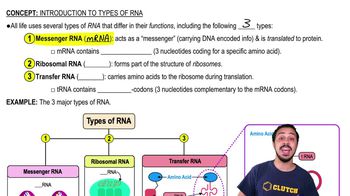
Recall that during translation, tRNA molecules carry amino acids to the ribosome and bind to the mRNA codon using their anticodon. The anticodon is complementary to the mRNA codon.
Determine the anticodon that pairs with the mRNA codon ACU. Using complementary base pairing rules, adenine (A) pairs with uracil (U), cytosine (C) pairs with guanine (G), and uracil (U) pairs with adenine (A). Thus, the anticodon is UGA.
Match the anticodon (UGA) to the correct answer choice in the problem. The correct answer is b. UGA.

Verified video answer for a similar problem:

This video solution was recommended by our tutors as helpful for the problem above.
Video duration:
1m
Was this helpful?

Key Concepts

Here are the essential concepts you must grasp in order to answer the question correctly.

DNA and RNA Transcription

DNA is transcribed into messenger RNA (mRNA) during the process of transcription. In this process, the DNA sequence is copied into a complementary RNA sequence, where thymine (T) in DNA is replaced by uracil (U) in RNA. Understanding this conversion is crucial for determining how codons in mRNA relate to the original DNA sequence.
Recommended video:
Guided course
04:16
1) Initiation of Transcription

Codons and Anticodons

Codons are sequences of three nucleotides in mRNA that correspond to specific amino acids or signal termination during protein synthesis. Anticodons are complementary sequences found on transfer RNA (tRNA) that pair with the mRNA codons during translation. This pairing is essential for the correct incorporation of amino acids into a growing polypeptide chain.
Recommended video:
Guided course
07:20
Introduction to Types of RNA

Base Pairing Rules

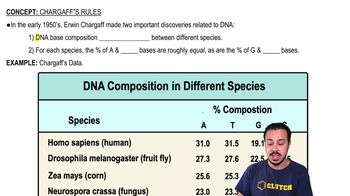
Base pairing rules dictate how nucleotides pair in DNA and RNA. In RNA, adenine (A) pairs with uracil (U), and cytosine (C) pairs with guanine (G). These rules are fundamental for understanding how the anticodon on tRNA matches with the codon on mRNA, allowing for accurate translation of genetic information into proteins.
Recommended video:
Guided course
04:33
Chargaff's Rules