RNA and DNA are similar because ________. a. Both are double-stranded helices. b. Uracil is found in both of them. c. Both contain the sugar deoxyribose. d. Both are made up of nucleotides consisting of a sugar, a phosphate, and a base.
Verified step by step guidance
1
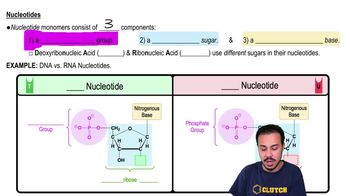
Step 1: Understand the structure of nucleic acids. Both RNA and DNA are nucleic acids, which are macromolecules made up of repeating units called nucleotides. Each nucleotide consists of three components: a sugar molecule, a phosphate group, and a nitrogenous base.
Step 2: Compare the sugars in RNA and DNA. DNA contains the sugar deoxyribose, while RNA contains the sugar ribose. This difference is crucial in distinguishing the two molecules.
Step 3: Examine the nitrogenous bases. DNA uses thymine (T) as one of its bases, while RNA uses uracil (U) instead of thymine. This is another key difference between the two molecules.
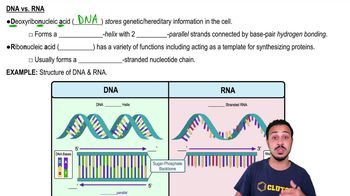
Step 4: Analyze the structural differences. DNA is typically double-stranded and forms a double helix, while RNA is usually single-stranded and does not form a double helix under normal conditions.
Step 5: Identify the correct similarity. Both RNA and DNA are made up of nucleotides consisting of a sugar, a phosphate group, and a nitrogenous base. This is the fundamental similarity between the two molecules.
Verified video answer for a similar problem:
This video solution was recommended by our tutors as helpful for the problem above
Video duration:
35s
Play a video:
Was this helpful?
Key Concepts
Here are the essential concepts you must grasp in order to answer the question correctly.
Nucleotides
Nucleotides are the building blocks of nucleic acids, such as DNA and RNA. Each nucleotide consists of three components: a sugar molecule, a phosphate group, and a nitrogenous base. In DNA, the sugar is deoxyribose, while in RNA, it is ribose. The sequence of these nucleotides encodes genetic information, making them essential for the structure and function of both DNA and RNA.
DNA (deoxyribonucleic acid) and RNA (ribonucleic acid) differ in several key aspects. DNA is typically double-stranded and contains the sugar deoxyribose, while RNA is usually single-stranded and contains ribose. Additionally, DNA uses thymine as one of its nitrogenous bases, whereas RNA uses uracil instead. These differences are crucial for their respective roles in genetic information storage and protein synthesis.
Base pairing refers to the specific hydrogen bonding between nitrogenous bases in nucleic acids. In DNA, adenine pairs with thymine, and cytosine pairs with guanine, forming the double helix structure. In RNA, adenine pairs with uracil instead of thymine. This complementary base pairing is fundamental for processes like DNA replication and RNA transcription, ensuring accurate genetic information transfer.