Pearson+ LogoPearson+ Logo
Ch. 9 - Biology of Wrongful Convictions
Belk, Maier - Biology: Science for Life 6th Edition
Belk, Maier6th EditionBiology: Science for LifeISBN: 9780135214084Not the one you use?Change textbook
Chapter 9, Problem 5

When graphing the phenotypes of a trait controlled by many genes and the environment, the line showing the frequency of each phenotype resembles ________.
a. A horizontal, straight line
b. A vertical, straight line
c. The letter T
d. A bell shape
e. A circle

Verified step by step guidance
1
Understand the problem: The question is asking about the distribution of phenotypes for a trait controlled by many genes (polygenic inheritance) and influenced by the environment. This is a key concept in genetics and population biology.
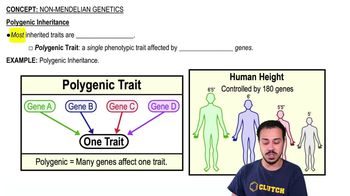
Recall the concept of polygenic traits: Traits controlled by many genes often show continuous variation (e.g., height, skin color). When graphed, the phenotypes typically form a distribution pattern.
Consider the role of the environment: Environmental factors can further influence the expression of these traits, leading to a range of phenotypes rather than discrete categories.
Identify the typical distribution: For polygenic traits influenced by the environment, the phenotypes usually follow a normal distribution, which is represented by a bell-shaped curve. This is because most individuals will have intermediate phenotypes, with fewer individuals at the extremes.
Match the description to the options: Based on the explanation, the correct answer is the option that describes a bell shape, as this matches the normal distribution of phenotypes for polygenic traits influenced by the environment.

Verified video answer for a similar problem:

This video solution was recommended by our tutors as helpful for the problem above.
Video duration:
3m
Was this helpful?

Key Concepts

Here are the essential concepts you must grasp in order to answer the question correctly.

Polygenic Inheritance

Polygenic inheritance refers to the phenomenon where multiple genes contribute to a single trait, resulting in a continuous range of phenotypes. This type of inheritance is common for traits such as height, skin color, and weight, where each gene adds a small effect to the overall phenotype.
Recommended video:
Guided course
02:27
Polygenic Inheritance

Phenotypic Distribution

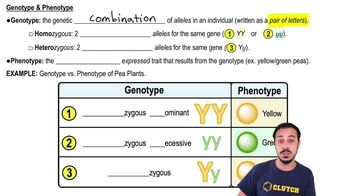
Phenotypic distribution describes how the various phenotypes of a trait are spread across a population. In cases of polygenic traits, this distribution often follows a normal distribution pattern, leading to a bell-shaped curve when graphed, indicating that most individuals exhibit intermediate phenotypes.
Recommended video:
Guided course
06:36
Genotype & Phenotype

Environmental Influence

Environmental influence refers to the impact that external factors, such as nutrition, climate, and lifestyle, have on the expression of genetic traits. These influences can modify the phenotypic outcomes of polygenic traits, further contributing to the variability observed in a population.
Recommended video:
Guided course
10:15
Environmental Tonicity Affects Cells
Related Practice
Textbook Question
What factors cause quantitative variation in a trait within a population?
1157
views
Textbook Question

The DNA profile below is from a mother, a father, and their child. Compare the bands found in the child's profile. What is true of every band shown in the child's profile?

1923
views
Textbook Question

A quantitative trait ________.

a. May be one that is strongly influenced by the environment

b. Varies continuously in a population

c. May be influenced by many genes

d. Is not either off or on

e. All of the above

1446
views
Textbook Question

When a trait is highly heritable, ________.

a. It is influenced by genes

b. It is not influenced by the environment

c. The variance of the trait in a population can be explained primarily by variance in genotypes

d. A and C are correct

e. A, B, and C are correct

1249
views
Textbook Question

Epigenetic changes involving methylation can directly affect the phenotype of an individual or her offspring by ________.

a. Causing correlations between parents and children

b. Causing changes to the DNA that affect gene expression but not DNA sequence

c. Generating low heritability

d. Increasing the likelihood of monozygotic twinning

e. Sterilizing the DNA

1517
views
Textbook Question

Which of the following is not part of the procedure used to make a DNA profile?

a. Short tandem repeat sequences are amplified by PCR.

b. DNA is placed in a gel and subjected to an electric current.

c. The genes that encode DNA sequence are cloned into bacteria.

d. DNA from blood, semen, vaginal fluids, or hair root cells can be used for analysis.

1091
views