A quantitative trait ________. a. May be one that is strongly influenced by the environment b. Varies continuously in a population c. May be influenced by many genes d. Is not either off or on e. All of the above
Verified step by step guidance
1
Understand the definition of a quantitative trait: A quantitative trait is a characteristic that shows continuous variation in a population and is typically influenced by multiple genes (polygenic inheritance) and environmental factors.
Analyze option (a): Determine if a quantitative trait can be strongly influenced by the environment. Recall that environmental factors often play a significant role in shaping quantitative traits, such as height or weight.
Analyze option (b): Check if a quantitative trait varies continuously in a population. Continuous variation means there are no distinct categories, and traits like skin color or height fall along a spectrum.
Analyze option (c): Evaluate if a quantitative trait may be influenced by many genes. Polygenic traits are controlled by multiple genes, each contributing a small effect to the overall phenotype.
Analyze option (d): Confirm if a quantitative trait is not either off or on. Unlike Mendelian traits (e.g., flower color being purple or white), quantitative traits do not have discrete states but instead show a range of values. Combine all the observations to determine if 'e. all of the above' is the correct answer.
Verified video answer for a similar problem:
This video solution was recommended by our tutors as helpful for the problem above
Video duration:
3m
Play a video:
0 Comments
Key Concepts
Here are the essential concepts you must grasp in order to answer the question correctly.
Quantitative Traits
Quantitative traits are characteristics that exhibit a continuous range of variation within a population, such as height or weight. Unlike qualitative traits, which are typically categorical (e.g., flower color), quantitative traits are influenced by multiple genetic and environmental factors, leading to a spectrum of phenotypes.
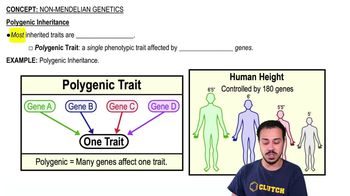
Polygenic inheritance refers to the phenomenon where multiple genes contribute to a single trait. Each gene may have a small additive effect on the phenotype, resulting in the continuous variation observed in quantitative traits. This complexity makes it challenging to predict the exact phenotype based solely on genotype.
The environment plays a significant role in shaping quantitative traits, as external factors can affect the expression of genes. For instance, nutrition, climate, and social interactions can modify phenotypic outcomes, demonstrating that traits are not solely determined by genetics but are also a product of environmental interactions.

 3:08 minutes
 Verified step by step guidance

 06:15
06:15