Pearson+ LogoPearson+ Logo
Ch. 1 Biology: The Study of Scientific Life
Taylor - Campbell Biology: Concepts & Connections 10th Edition
Taylor, Simon, Dickey, Hogan10th EditionCampbell Biology: Concepts & ConnectionsISBN: 9780136538783Not the one you use?Change textbook
Chapter 1, Problem 8

A biologist studying interactions among the bacteria in an ecosystem could not be working at which level in life's hierarchy? (Choose carefully and explain your answer.)
a. The population level
b. The molecular level
c. The organism level
d. The organ level

Verified step by step guidance
1
Step 1: Begin by understanding the levels of biological organization. Life's hierarchy includes levels such as molecules, cells, tissues, organs, organisms, populations, communities, ecosystems, and the biosphere.
Step 2: Analyze the question. The biologist is studying interactions among bacteria in an ecosystem. This implies a focus on how bacteria interact with each other and their environment, which is relevant to certain levels of biological organization.
Step 3: Evaluate each option: (a) Population level refers to a group of organisms of the same species living in a specific area, which could include bacteria. (b) Molecular level involves studying molecules like DNA, proteins, or other biochemical components, which is not directly about interactions among bacteria. (c) Organism level focuses on individual organisms, which could include bacteria. (d) Organ level refers to structures within multicellular organisms, which is not applicable to bacteria as they are unicellular.
Step 4: Determine which level is least relevant to the study of bacterial interactions. Since bacteria are unicellular and do not have organs, the organ level is not applicable to this study.
Step 5: Conclude that the biologist could not be working at the organ level when studying interactions among bacteria in an ecosystem, as bacteria lack organs.

Verified video answer for a similar problem:

This video solution was recommended by our tutors as helpful for the problem above.
Video duration:
55s
Was this helpful?

Key Concepts

Here are the essential concepts you must grasp in order to answer the question correctly.

Levels of Biological Organization

Biological organization is structured in a hierarchy, ranging from atoms and molecules to cells, tissues, organs, organisms, populations, communities, ecosystems, and the biosphere. Each level represents a different scale of biological complexity, with interactions occurring at each level. Understanding this hierarchy is crucial for identifying the appropriate level of study for specific biological interactions.
Recommended video:
Guided course
06:04
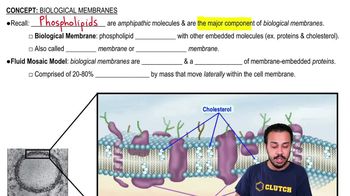
Biological Membranes

Population Level

The population level refers to a group of individuals of the same species living in a specific area, interacting with one another. In the context of bacteria, studying populations involves examining how these microorganisms interact, compete, and coexist within their environment. This level is essential for understanding ecological dynamics and the roles of different species in an ecosystem.
Recommended video:
Guided course
02:58
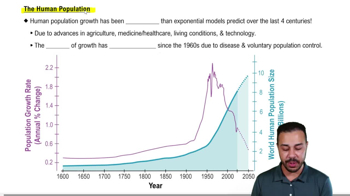
The Human Population

Molecular and Organ Levels

The molecular level focuses on the interactions and functions of biomolecules, such as DNA, proteins, and lipids, while the organ level pertains to groups of tissues working together to perform specific functions within an organism. A biologist studying bacterial interactions would not typically operate at the organ level, as bacteria do not form organs, and molecular studies would be more focused on individual components rather than community interactions.
Recommended video:
Guided course
06:52
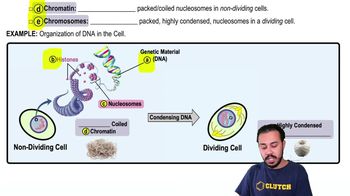
Organization of DNA in the Cell