Pearson+ LogoPearson+ Logo
Ch. 13 How Populations Evolve
Taylor - Campbell Biology: Concepts & Connections 10th Edition
Taylor, Simon, Dickey, Hogan10th EditionCampbell Biology: Concepts & ConnectionsISBN: 9780136538783Not the one you use?Change textbook
Chapter 13, Problem 1

Summarize the key points of Darwin's theory of descent with modification, including his proposed mechanism of evolution.

Verified step by step guidance
1
Identify the core concept of Darwin's theory, which is that all species of organisms arise and develop through the natural selection of small, inherited variations that increase the individual's ability to compete, survive, and reproduce.
Explain 'descent with modification' by stating that it suggests all organisms on Earth are connected through descent from a common ancestor that lived in the remote past. Over time, species diverge from this common ancestor, leading to the vast diversity of life seen today.
Discuss the role of natural selection in Darwin's theory. Natural selection is the process by which traits that enhance survival and reproduction become more common in successive generations of a population. It acts on the variation among individuals within a population, which arises from random mutations and sexual reproduction.
Highlight the importance of variation for natural selection to occur. Without genetic variation, all individuals would be identical, and natural selection would have no material to work on.
Mention the impact of Darwin's theory on the scientific community and its status as a foundational concept in biology, which provides a unifying explanation for the adaptation and diversity of all life on Earth.

Verified video answer for a similar problem:

This video solution was recommended by our tutors as helpful for the problem above.
Video duration:
37s
Was this helpful?

Key Concepts

Here are the essential concepts you must grasp in order to answer the question correctly.

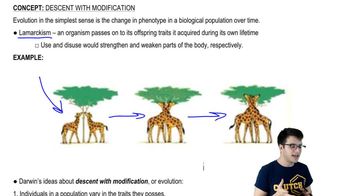
Descent with Modification

Descent with modification is a fundamental concept in Darwin's theory of evolution, which posits that species change over time through a process of gradual modification. This means that descendants of a common ancestor will exhibit variations that can accumulate, leading to the emergence of new species. This concept emphasizes the idea that all living organisms are related through a shared lineage.
Recommended video:
Guided course
04:52
Descent With Modification

Natural Selection

Natural selection is the mechanism proposed by Darwin to explain how evolution occurs. It suggests that individuals with traits better suited to their environment are more likely to survive and reproduce, passing those advantageous traits to the next generation. Over time, this process can lead to significant changes in a population, as beneficial traits become more common while less advantageous traits diminish.
Recommended video:
04:43
Natural Selection

Variation and Adaptation

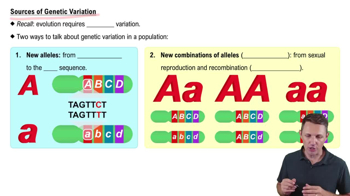
Variation refers to the differences in traits among individuals within a population, which are crucial for the process of natural selection. Adaptation is the process by which a species becomes better suited to its environment through these variations. These adaptations can be structural, behavioral, or physiological, and they enhance an organism's chances of survival and reproduction in a specific habitat.
Recommended video:
02:16
Sources of Genetic Variation