Pearson+ LogoPearson+ Logo
Ch. 5 The Working Cell
Taylor - Campbell Biology: Concepts & Connections 10th Edition
Taylor, Simon, Dickey, Hogan10th EditionCampbell Biology: Concepts & ConnectionsISBN: 9780136538783Not the one you use?Change textbook
Chapter 5, Problem 10

Relate the laws of thermodynamics to living organisms.

Verified step by step guidance
1
Understand the First Law of Thermodynamics, which states that energy cannot be created or destroyed, only transformed from one form to another. In biological systems, this means that the energy organisms take in from the environment (e.g., through sunlight in plants or food in animals) is converted into usable chemical energy, which is then used for biological processes such as growth, reproduction, and maintenance.
Examine the Second Law of Thermodynamics, which states that every energy transfer or transformation increases the entropy (disorder) of the universe. For living organisms, this implies that while they can maintain or decrease internal entropy by organizing molecules into complex structures (like proteins and DNA), the overall entropy of the surroundings increases as a result of metabolic processes, such as the release of heat and waste products.
Apply these laws to metabolic processes. For example, during cellular respiration, glucose is broken down and the energy released is used to form ATP (adenosine triphosphate), the energy currency of cells. This process is consistent with the first law as energy is conserved and transformed. According to the second law, the breakdown of glucose increases the universe's total entropy.
Consider how organisms maintain homeostasis in light of these laws. Homeostasis involves biological systems maintaining internal stability (low entropy) despite changes in external conditions. This is achieved through constant energy transformations, which are governed by the laws of thermodynamics.
Reflect on the evolutionary implications of thermodynamics. Organisms that are more efficient at transforming energy and managing entropy are likely to have a survival advantage, influencing evolutionary pathways and the development of complex life forms.

Verified video answer for a similar problem:

This video solution was recommended by our tutors as helpful for the problem above.
Video duration:
1m
Was this helpful?

Key Concepts

Here are the essential concepts you must grasp in order to answer the question correctly.

First Law of Thermodynamics

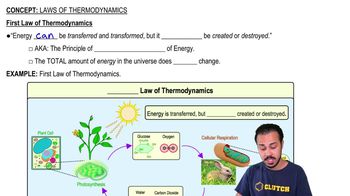
The First Law of Thermodynamics, also known as the law of energy conservation, states that energy cannot be created or destroyed, only transformed from one form to another. In living organisms, this principle is evident as they convert energy from food into usable forms, such as ATP, to power cellular processes.
Recommended video:
Guided course
04:43
First Law of Thermodynamics

Second Law of Thermodynamics

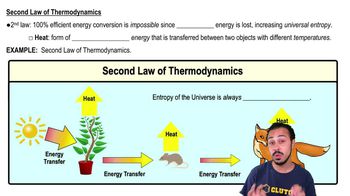
The Second Law of Thermodynamics states that in any energy transfer, the total entropy of a closed system will always increase over time. For living organisms, this means that while they maintain order and complexity, they must constantly take in energy from their environment to counteract the natural tendency toward disorder.
Recommended video:
Guided course
02:53
Second Law of Thermodynamics

Metabolism

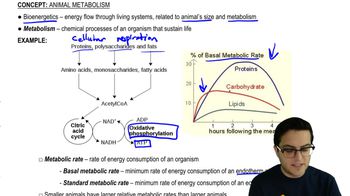
Metabolism encompasses all the biochemical reactions that occur within living organisms to maintain life. It includes catabolic pathways that break down molecules to release energy and anabolic pathways that use energy to build cellular components, illustrating how organisms adhere to the laws of thermodynamics by transforming energy to sustain their biological functions.
Recommended video:
Guided course
07:08
Metabolic Rate