Pearson+ LogoPearson+ Logo
Ch. 5 The Working Cell
Taylor - Campbell Biology: Concepts & Connections 10th Edition
Taylor, Simon, Dickey, Hogan10th EditionCampbell Biology: Concepts & ConnectionsISBN: 9780136538783Not the one you use?Change textbook
Chapter 5, Problem 11

How do the components and structure of cell membranes relate to the functions of membranes?

Verified step by step guidance
1
Understand that the cell membrane, also known as the plasma membrane, is primarily composed of a phospholipid bilayer, which provides a semi-permeable barrier between the cell's internal environment and the external environment.
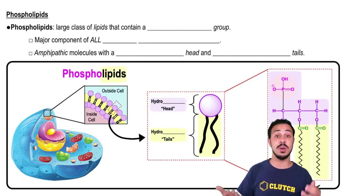
Recognize that the hydrophilic (water-attracting) heads of the phospholipids face outward toward the aqueous environments, while the hydrophobic (water-repelling) tails face inward, creating a hydrophobic core that regulates the passage of substances.
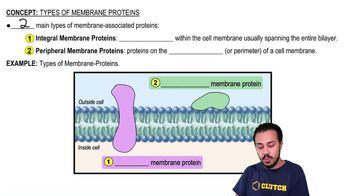
Identify the role of membrane proteins, which are embedded within or associated with the phospholipid bilayer. These proteins serve various functions, such as transport (e.g., channel and carrier proteins), signal transduction (e.g., receptor proteins), and enzymatic activity.
Acknowledge the presence of cholesterol molecules within the membrane, which help maintain fluidity and stability, especially under varying temperature conditions.
Understand the role of carbohydrates attached to lipids (glycolipids) or proteins (glycoproteins) on the membrane surface. These structures are involved in cell recognition, signaling, and adhesion, which are critical for communication and interaction with other cells.

Verified video answer for a similar problem:

This video solution was recommended by our tutors as helpful for the problem above.
Video duration:
2m
Was this helpful?

Key Concepts

Here are the essential concepts you must grasp in order to answer the question correctly.

Phospholipid Bilayer

The phospholipid bilayer is the fundamental structure of cell membranes, consisting of two layers of phospholipids with hydrophilic heads facing outward and hydrophobic tails facing inward. This arrangement creates a semi-permeable barrier that regulates the movement of substances in and out of the cell, allowing for selective permeability essential for cellular function.
Recommended video:
Guided course
04:05
Phospholipids

Membrane Proteins

Membrane proteins are integral and peripheral proteins embedded in or associated with the phospholipid bilayer. They play crucial roles in various functions, including transport, signaling, and structural support. For example, channel proteins facilitate the passage of ions and molecules, while receptor proteins transmit signals from the external environment to the cell's interior.
Recommended video:
Guided course
02:35
Types of Membrane Proteins

Fluid Mosaic Model

The fluid mosaic model describes the cell membrane as a dynamic and flexible structure where lipids and proteins can move laterally within the layer. This model emphasizes the heterogeneous composition of membranes, allowing for diverse functions such as cell communication, transport, and maintaining homeostasis, as the fluidity enables the membrane to adapt to changing conditions.
Recommended video:
Guided course
01:09
Introduction to Population Growth Models
Related Practice
Textbook Question
What are the main types of cellular work? How does ATP provide the energy for this work?
2009
views
Textbook Question
Why is the barrier of the activation energy beneficial for cells? Explain how enzymes lower activation energy.
1989
views
Textbook Question
Relate the laws of thermodynamics to living organisms.
1783
views
Textbook Question
Sometimes inhibitors can be harmful to a cell; often they are beneficial. Explain.
1923
views
Textbook Question

Cells lining kidney tubules function in the reabsorption of water from urine. In response to chemical signals, they reversibly insert additional aquaporins into their plasma membranes. In which of these situations would your tubule cells have the most aquaporins: after a long run on a hot day, right after a large meal, or after drinking a large bottle of water? Explain.

1452
views
Textbook Question

Mercury is known to inhibit the permeability of water channels. To help establish that the protein isolated by Agre's group was a water channel, the researchers incubated groups of RNA-injected oocytes (which thus made aquaporin proteins) in four different solutions: plain buffer, low concentration and high concentration of a mercury chloride (HgCl₂) solution, and low concentration of a mercury solution followed by an agent (ME) known to reverse the effects of mercury. The water permeability of the cells was determined by the rate of their osmotic swelling. Interpret the results of this experiment, which are presented in the graph below. Control oocytes not injected with aquaporin RNA were also incubated with buffer and the two concentrations of mercury. Predict what the results of these treatments would be.

<IMAGE>

1548
views