Pearson+ LogoPearson+ Logo
Ch. 5 The Working Cell
Taylor - Campbell Biology: Concepts & Connections 10th Edition
Taylor, Simon, Dickey, Hogan10th EditionCampbell Biology: Concepts & ConnectionsISBN: 9780136538783Not the one you use?Change textbook
Chapter 5, Problem 12

Sometimes inhibitors can be harmful to a cell; often they are beneficial. Explain.

Verified step by step guidance
1
Understand the role of inhibitors in biological systems: Inhibitors are molecules that can bind to enzymes and decrease their activity. This interaction can either be reversible or irreversible depending on the nature of the inhibitor and the enzyme.
Recognize the harmful effects of inhibitors: In some cases, inhibitors can be harmful if they disrupt necessary biochemical pathways. For example, toxins or poisons often act as inhibitors, blocking essential enzymatic activities and leading to cellular damage or death.
Identify the beneficial effects of inhibitors: Inhibitors can also play a protective role in cells. They can regulate metabolic pathways to prevent overproduction of certain substances that might be harmful in excess. For instance, drugs used to lower cholesterol levels work by inhibiting specific enzymes involved in cholesterol synthesis.
Consider therapeutic uses of inhibitors: Many medications are inhibitors designed to target specific enzymes associated with diseases. By inhibiting these enzymes, the drugs help to manage or cure the disease. For example, protease inhibitors are used in the treatment of HIV/AIDS to prevent the virus from replicating.
Explore the role of inhibitors in research: Inhibitors are valuable tools in biological research. They are used to study enzyme mechanisms and functions by observing how the inhibition affects cellular processes. This helps scientists understand how enzymes work and how they can be manipulated for beneficial purposes.

Verified video answer for a similar problem:

This video solution was recommended by our tutors as helpful for the problem above.
Video duration:
1m
Was this helpful?

Key Concepts

Here are the essential concepts you must grasp in order to answer the question correctly.

Enzyme Inhibition

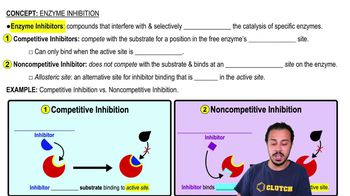
Enzyme inhibition refers to the process where a molecule, known as an inhibitor, binds to an enzyme and decreases its activity. This can occur through various mechanisms, such as competitive inhibition, where the inhibitor competes with the substrate for the active site, or non-competitive inhibition, where the inhibitor binds to a different site. Understanding this concept is crucial for grasping how inhibitors can regulate metabolic pathways.
Recommended video:
Guided course
05:03
Enzyme Inhibition

Cellular Regulation

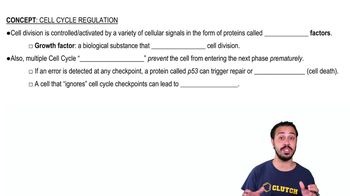
Cells utilize inhibitors as a means of regulating biochemical pathways to maintain homeostasis. Inhibitors can prevent overactivity of enzymes, ensuring that metabolic processes occur at appropriate rates. This regulation is essential for cellular function, as it allows cells to respond to changes in their environment and manage energy resources effectively.
Recommended video:
Guided course
03:31
Cell Cycle Regulation

Toxicity vs. Therapeutic Effects

While some inhibitors can be toxic and disrupt normal cellular functions, others are used therapeutically to treat diseases. For example, certain drugs act as enzyme inhibitors to slow down the progression of diseases like cancer or bacterial infections. The distinction between harmful and beneficial effects of inhibitors often depends on their concentration, target specificity, and the context of their use within the organism.
Recommended video:
Guided course
03:39
Dominant vs. Recessive Alleles
Related Practice
Textbook Question
Why is the barrier of the activation energy beneficial for cells? Explain how enzymes lower activation energy.
1989
views
Textbook Question
Relate the laws of thermodynamics to living organisms.
1783
views
Textbook Question

How do the components and structure of cell membranes relate to the functions of membranes?

1564
views
Textbook Question

Cells lining kidney tubules function in the reabsorption of water from urine. In response to chemical signals, they reversibly insert additional aquaporins into their plasma membranes. In which of these situations would your tubule cells have the most aquaporins: after a long run on a hot day, right after a large meal, or after drinking a large bottle of water? Explain.

1452
views
Textbook Question

Mercury is known to inhibit the permeability of water channels. To help establish that the protein isolated by Agre's group was a water channel, the researchers incubated groups of RNA-injected oocytes (which thus made aquaporin proteins) in four different solutions: plain buffer, low concentration and high concentration of a mercury chloride (HgCl₂) solution, and low concentration of a mercury solution followed by an agent (ME) known to reverse the effects of mercury. The water permeability of the cells was determined by the rate of their osmotic swelling. Interpret the results of this experiment, which are presented in the graph below. Control oocytes not injected with aquaporin RNA were also incubated with buffer and the two concentrations of mercury. Predict what the results of these treatments would be.

<IMAGE>

1548
views
Textbook Question

A biologist performed two series of experiments on lactase, the enzyme that hydrolyzes lactose to glucose and galactose. First, she made up 10% lactose solutions containing different concentrations of enzyme and measured the rate at which galactose was produced (grams of galactose per minute). Results of these experiments are shown in Table A below. In the second series of experiments (Table B), she prepared 2% enzyme solutions containing different concentrations of lactose and again measured the rate of galactose production.

Graph and explain the relationship between the reaction rate and the enzyme concentration.

<IMAGE>

1318
views